Chinatown Vancouver — history, the classical garden, and what to see
Vancouver City Tour + VIP Car + Stanley Park + Chinatown (Small Group)
What makes Vancouver's Chinatown historically significant?
Vancouver's Chinatown is one of the oldest and largest historic Chinatowns in North America, dating to the 1880s. Its history includes the Chinese head tax, the 1907 anti-Asian riot, and decades of legally sanctioned discrimination, alongside a resilient community that built lasting institutions — including the Dr. Sun Yat-Sen Classical Chinese Garden, the first full-scale classical Chinese garden built outside China.
Vancouver’s Chinatown is one of the oldest and, historically, largest Chinatowns in North America, and its story is inseparable from a difficult history of legally sanctioned discrimination against Chinese immigrants in British Columbia. Understanding that history changes how the neighbourhood’s surviving heritage buildings, gardens, and institutions read today — not just as a pleasant place to eat dim sum, but as evidence of a community that persisted through decades of deliberate exclusion.
| Where | Southeast of Gastown and downtown, near Pender/Main |
| Cost to visit | Free to walk; Dr. Sun Yat-Sen Garden is paid admission |
| Time needed | 2-3 hours for the core sights, longer with a meal |
| Getting there | Stadium-Chinatown SkyTrain (Expo/Millennium lines) |
| Don’t miss | Dr. Sun Yat-Sen Garden, Sam Kee Building, Millennium Gate |
Vancouver’s Chinatown has weathered demolition threats, economic decline, and, more recently, competition from newer Chinese commercial districts elsewhere in Metro Vancouver, and it remains one of the city’s most historically significant neighbourhoods precisely because so much of its original built environment survives intact.
Early settlement and the head tax
Chinese immigration to British Columbia accelerated during the 1858 Fraser Canyon gold rush and again during the 1880s construction of the Canadian Pacific Railway, where Chinese labourers made up a large share of the workforce on the most dangerous sections of track, at lower pay and under harsher conditions than other workers, with a significant number dying during construction.
Once the railway was completed, the federal government imposed a head tax specifically on Chinese immigrants starting in 1885 — an escalating fee, eventually reaching 500 dollars per person by 1903, a sum equivalent to roughly two years’ wages, designed explicitly to discourage further Chinese immigration. Vancouver’s Chinatown grew during this period as a community both drawn together by mutual support and pushed together by discriminatory housing and business restrictions elsewhere in the city.
The 1907 anti-Asian riot
In September 1907, a mob organized by the Asiatic Exclusion League marched through Vancouver and attacked both Chinatown and the nearby Japanese community, smashing windows and damaging businesses over two nights of violence. The riot remains one of the most significant and shameful events in the city’s history, and it’s a direct, concrete illustration of the hostility Chinatown’s community faced beyond the more abstract policy discrimination of the head tax and, later, the 1923 Chinese Immigration Act, which effectively banned nearly all Chinese immigration to Canada until its repeal in 1947.
Building a community despite exclusion
Despite — and in direct response to — this hostility, Chinatown’s community built lasting institutions through the early 20th century: family associations, benevolent societies, and eventually the neighbourhood’s distinctive recessed-balcony commercial architecture, designed partly to maximize usable space on narrow lots and partly reflecting styles brought from Guangdong province, the origin point for most of the community’s early immigrants. Many of these buildings, including the Sam Kee Building — famously recognized as the narrowest commercial building in the world, built in 1913 on a strip of land only 1.8 metres deep after the city expropriated most of the original lot — survive today as protected heritage structures.
The Dr. Sun Yat-Sen Classical Chinese Garden
The neighbourhood’s best-known cultural attraction, the Dr. Sun Yat-Sen Classical Chinese Garden, opened in 1986 as the first full-scale classical Chinese garden built outside China, constructed by artisans brought from Suzhou using traditional techniques and materials, including rocks imported specifically from Lake Tai in China.
It’s a Ming Dynasty-style scholar’s garden — designed around principles of balance, borrowed scenery, and carefully framed views rather than open lawns or colourful flower beds — and it rewards a slower, more contemplative visit than a typical city park. An adjacent free public park, built in a similar but less formally landscaped style, offers a lower-cost alternative for visitors who want a taste of the garden’s aesthetic without the paid admission to the classical garden itself.
Seeing Chinatown with a guide
For visitors who want the neighbourhood’s history explained on-site rather than researched independently, a Vancouver city tour including Chinatown combines a Chinatown stop with other major sights in a single guided itinerary, useful for travelers without much dedicated time but who still want historical context delivered directly rather than self-guided.
For a food-focused alternative that touches on Chinatown as part of a broader downtown food route, a Gastown walking food tour passes near the neighbourhood’s edge, worth combining with a dedicated Chinatown stop given the two districts’ geographic proximity.
The night market
During summer months, Chinatown hosts its own evening night market, drawing on the same food-stall and street-vendor format popularized by the larger Richmond Night Market but on a smaller, more neighbourhood-scaled level. It runs seasonally rather than year-round, and gives visitors a livelier, later-evening alternative to the neighbourhood’s typically quieter daytime pace, worth checking the current summer schedule for if evening availability fits a trip’s timing.
Food and dim sum culture
Chinatown remains one of Vancouver’s strongest dim sum destinations, though it now shares that reputation with Richmond’s larger, more contemporary Chinese dining scene. Traditional cart-service dim sum, where servers wheel steaming trays between tables for diners to select from directly, is increasingly rare even within Chinatown itself as many restaurants have shifted to order-sheet formats, so seeking out one of the remaining cart-service spots is worth the extra research for visitors specifically wanting that classic experience rather than the now more common alternative.
Modern challenges and revitalization
Like many historic Chinatowns across North America, Vancouver’s has faced real economic pressure in recent decades — an aging original business base, competition from Richmond’s newer Chinese commercial districts, and, more recently, the broader challenges facing the adjacent Downtown Eastside. Community organizations and the city have pursued various revitalization efforts, balancing heritage preservation against the neighbourhood’s ongoing economic and social challenges, an evolving situation rather than a settled one. Visitors should approach the neighbourhood with this context rather than expecting a purely polished, tourist-oriented experience throughout.
Booking a dedicated historical tour
For visitors who want Chinatown’s history explained by a knowledgeable guide rather than relying on this overview and posted signage alone, a private Vancouver historical and heritage tour can be arranged to focus specifically on Chinatown and its surrounding Downtown Eastside context, giving considerably more depth than a general city sightseeing tour that treats the neighbourhood as a brief photo stop. This is a worthwhile investment for visitors with a genuine interest in the head tax era, the 1907 riot, and the community’s subsequent history, topics that reward guided context more than most of the city’s other historic districts.
Combining Chinatown with Gastown and Granville Island
Chinatown pairs naturally with a broader historic-Vancouver day that also includes Gastown, given their short walking distance from each other and their shared, if distinct, 19th-century origins. Visitors with a full day and an interest in markets alongside history might also extend the day toward Granville Island Market, though that requires a longer transit or driving leg rather than a simple extension of the same walking route.
Practical visiting notes
Chinatown is a short walk from Gastown, making it easy to combine both in a single outing, and it’s well served by transit given its proximity to the Stadium-Chinatown SkyTrain station. Most of the neighbourhood’s key sights — the Dr. Sun Yat-Sen Garden, the Sam Kee Building, and the main commercial stretch along Pender and Main Streets — are within a compact, walkable area covered comfortably in an hour or two, longer if a meal is part of the visit.
Redress and formal apologies
The head tax and broader exclusionary policies against Chinese immigrants were formally acknowledged decades later through official government apologies — the federal government issued a formal apology and symbolic redress payments to surviving head tax payers and their families in 2006, and the province of British Columbia issued its own apology in 2014 specifically addressing BC-level discriminatory laws, including restrictions on Chinese Canadians’ right to vote, own property, and enter certain professions that persisted well into the 20th century.
These formal apologies are relatively recent, within living memory for many community members, and understanding that timeline underscores how long this history remained officially unaddressed.
The Chinese Canadian Museum
Opened in 2023 in Chinatown’s historic Wing Sang Building — itself Chinatown’s oldest surviving structure, built in 1889 — the Chinese Canadian Museum is the first museum in Canada dedicated specifically to Chinese Canadian history, covering the head tax era, the Exclusion Act years, wartime contributions, and the community’s ongoing evolution through to the present day. It’s a significant recent addition to the neighbourhood’s cultural offerings and one of the more direct ways for visitors to engage with this history in depth, beyond what’s covered through walking-tour commentary or interpretive plaques around the neighbourhood.
The Chinatown Storytelling Centre
A smaller, community-run space, the Chinatown Storytelling Centre focuses on oral histories and first-person accounts from Chinatown’s residents and business owners across generations, offering a more intimate, community-voiced counterpoint to the larger Chinese Canadian Museum’s broader historical scope. Together, the two institutions give visitors both the macro historical context and individual, personal stories from within the community itself.
The Millennium Gate
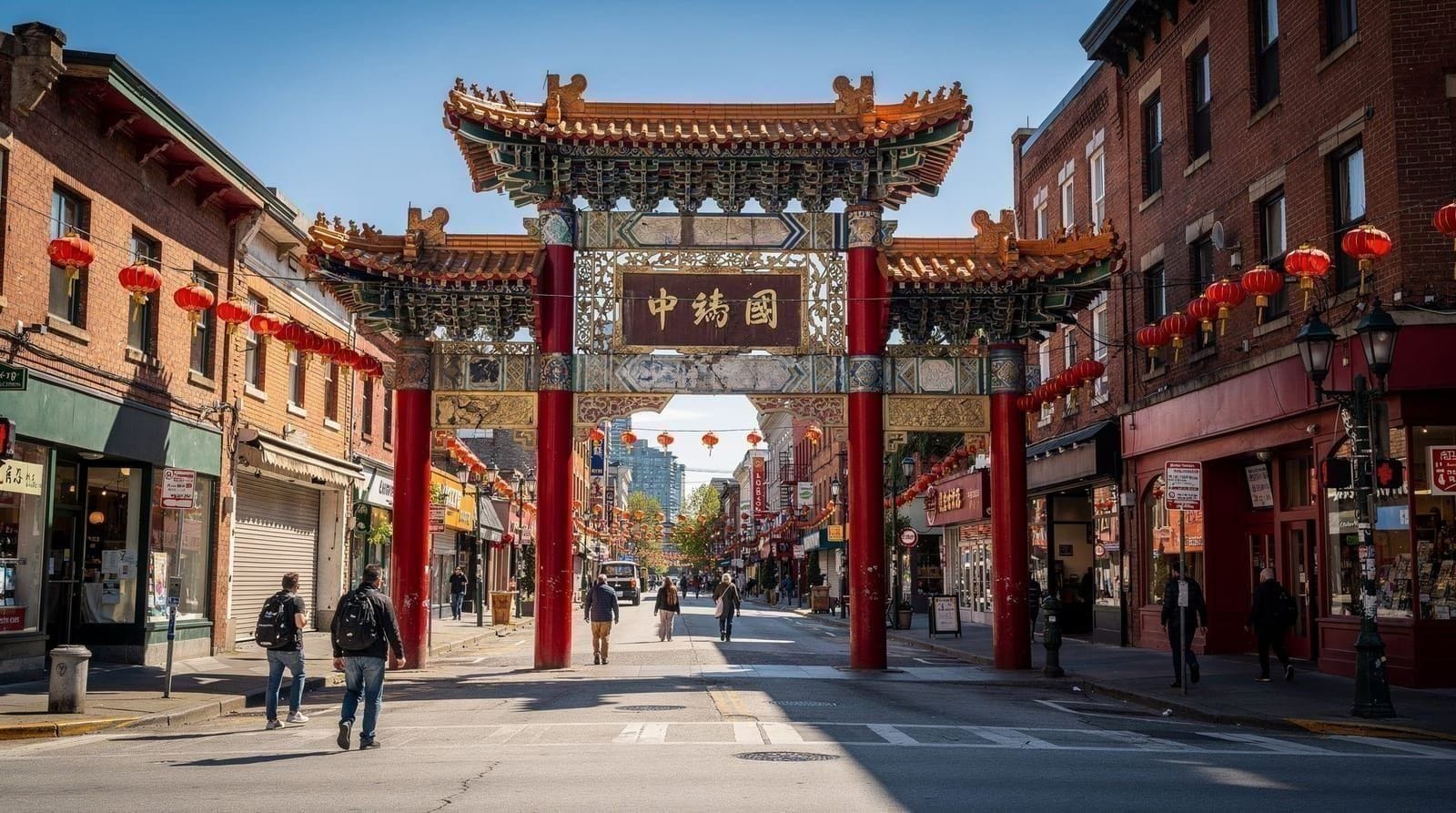
Spanning Pender Street at the neighbourhood’s western entrance, the Millennium Gate is Chinatown’s most recognizable single landmark after the Dr. Sun Yat-Sen Garden — a ceremonial arch built in 2002 to mark the neighbourhood’s gateway, styled after traditional Chinese memorial arches and funded partly through community and government contributions. It’s a natural photo stop and orientation point for visitors beginning a Chinatown walk from the Gastown side of the neighbourhood.
Lunar New Year in Chinatown
Chinatown hosts Vancouver’s largest Lunar New Year celebrations, typically including a parade, lion and dragon dance performances, and a significantly livelier atmosphere than the neighbourhood’s usual daily pace, drawing visitors from across the region rather than just Chinatown’s immediate community. Dates shift annually according to the lunar calendar, typically falling between late January and mid-February, and travelers whose trip happens to align with the celebration should treat it as a genuine highlight worth adjusting plans around rather than a minor scheduling curiosity.
Comparing Chinatown to Richmond’s Chinese food scene
Visitors familiar with Richmond’s more contemporary Chinese dining scene, including its well-known night market and dense concentration of mainland Chinese and Taiwanese restaurants, sometimes wonder how it compares to Chinatown’s offerings. The two serve genuinely different purposes: Chinatown represents the older, historically Cantonese immigrant community’s food traditions and heritage architecture, while Richmond’s scene reflects more recent immigration patterns and a broader range of contemporary regional Chinese cuisines. Visitors with time for both get a more complete picture of Chinese Canadian culinary history in the region than either neighbourhood alone provides.
Architecture worth looking for
Beyond the Sam Kee Building’s famous narrowness, Chinatown’s characteristic recessed-balcony architecture — upper-floor balconies set back from the street facade, originally used for housing above ground-floor businesses — represents a distinct regional adaptation of styles brought from Guangdong province, rarely seen outside historic Chinatowns of this era. Several buildings along Pender Street retain this feature, along with decorative ironwork balcony railings and traditional Chinese architectural motifs incorporated into otherwise Edwardian-era commercial building forms, a genuine architectural hybrid that developed specifically within North American Chinatowns rather than being imported wholesale from China.
Family associations and tongs
Scattered throughout Chinatown, unmarked or subtly marked buildings still house family and clan associations — organizations originally formed to provide mutual support, housing, and social connection for immigrants from the same extended family or home region in China, at a time when mainstream Canadian institutions offered little support and considerable hostility to new Chinese immigrants. Many of these associations remain active today, though their public visibility has diminished considerably from Chinatown’s mid-20th-century peak, and their buildings are generally not open to casual visitors, functioning instead as ongoing community institutions rather than tourist sites.
The evolving Downtown Eastside context
Chinatown sits at the edge of Vancouver’s Downtown Eastside, an area facing well-documented and visible challenges around homelessness, addiction, and poverty, and this proximity affects the visitor experience in ways worth acknowledging honestly rather than glossing over. Some blocks within and adjacent to Chinatown show visible signs of these challenges, and the neighbourhood’s business community has been vocal about the impact on foot traffic and safety perceptions in recent years. Most visitors experience the neighbourhood’s core historic and cultural sites without incident, but arriving with realistic expectations, rather than an idealized postcard image, makes for a better-informed visit.
Shopping for traditional goods
Beyond restaurants, Chinatown retains a number of traditional herbalists, grocers, and specialty shops selling goods not easily found elsewhere in the city — dried seafood, traditional Chinese medicine ingredients, and imported goods catering to a longstanding local Chinese Canadian clientele rather than tourists specifically. Browsing these shops, even without purchasing anything, gives a more grounded sense of the neighbourhood’s ongoing function as a working commercial district rather than purely a historic tourist attraction.
Public art and memorials
Beyond the Millennium Gate, Chinatown holds several smaller memorials and public art pieces worth watching for on a walking visit, including markers commemorating the Chinese railway workers whose labour built the western section of the Canadian Pacific Railway and monuments acknowledging Chinese Canadian veterans who served in the Second World War despite facing discrimination at home, including denial of the vote, at the time of their service.
These pieces are easy to walk past without noticing if you’re not specifically looking, but they add meaningful texture to a visit for anyone reading this history as more than a background fact — a reminder that the community’s contributions to the wider province extended well beyond the neighbourhood’s own boundaries.
Getting there and orientation
Chinatown sits immediately southeast of Gastown and downtown, served directly by the Stadium-Chinatown SkyTrain station on the Expo and Millennium lines, making it one of the more transit-accessible historic districts in the city. Walking from Waterfront Station or the main downtown core takes roughly 15 to 20 minutes, and the neighbourhood’s core sights cluster tightly enough along Pender, Main, and Keefer Streets that a visitor can cover the Millennium Gate, the Dr. Sun Yat-Sen Garden, the Sam Kee Building, and the Chinese Canadian Museum on foot within a single loop lasting two to three hours, longer with a meal included.
Combining Chinatown with a broader Vancouver day
Chinatown works best paired with other downtown-adjacent history rather than as a standalone half-day trip — most visitors combine it with Gastown given the short walk between the two, or extend a downtown sightseeing day that already includes Canada Place or the Vancouver Art Gallery.
Visitors building a broader first Vancouver itinerary can see how a Chinatown stop fits alongside the city’s other major sights in the 3-day Vancouver plan or the more general first-time Vancouver guide, both of which treat the historic core — Gastown, Chinatown, and downtown — as a single connected half-day rather than three separate outings.
The honest verdict
Vancouver’s Chinatown carries a genuinely significant and difficult history that’s easy to walk past without registering if you don’t know the specifics — the head tax, the 1907 riot, and decades of exclusion aren’t abstract historical footnotes here but the direct reason the neighbourhood exists in its current form. Combined with the Dr. Sun Yat-Sen Garden’s genuine architectural significance, it’s a neighbourhood that rewards visitors who spend a little time understanding the history before or during their visit, rather than treating it purely as a dim sum stop between other downtown sights.
Frequently asked questions — Chinatown Vancouver
How much time should I budget for Chinatown?
Two to three hours covers the Dr. Sun Yat-Sen Garden, the Sam Kee Building, the Millennium Gate and the main commercial stretch along Pender and Main Streets at a comfortable pace, longer if a dim sum meal is part of the visit.Is Vancouver's Chinatown safe to visit?
Most visitors experience the neighbourhood's core historic and cultural sites without incident during the day, though Chinatown borders part of the Downtown Eastside and some edge streets show visible signs of that area's social challenges. Sticking to the busier, well-trafficked blocks around meal times is the sensible default.
Top experiences
Bookable activities with verified prices and instant confirmation on GetYourGuide.