Vancouver Art Gallery — what's inside and whether it's worth your time
Vancouver: City Highlights Tour with Hotel Transfers
Is the Vancouver Art Gallery worth visiting?
Yes, particularly for the Emily Carr collection, one of the largest anywhere, and for the building itself — a converted 1906 provincial courthouse that's a heritage landmark in its own right. Most visitors spend 1.5 to 2.5 hours here, and it's centrally located, making it easy to combine with other downtown sightseeing.
The Vancouver Art Gallery sits in a converted 1906 provincial courthouse in the middle of downtown, and that history is worth knowing before stepping inside — the building itself, not just the collection, is a significant piece of the city’s architectural heritage, repurposed rather than purpose-built for its current role.
| Where | Robson Square, downtown Vancouver |
| Cost | Moderate for a major city gallery; reduced student/senior rates |
| Time needed | 1.5-2.5 hours |
| Getting there | Walkable from most downtown hotels |
| Best time | Weekday mornings, shortly after opening |
A courthouse turned gallery
The building that now houses the Vancouver Art Gallery was originally the provincial courthouse, designed by Francis Rattenbury — the same architect behind Victoria’s Parliament Buildings and the Fairmont Empress hotel — and completed in 1906 in a grand Beaux-Arts style with a domed rotunda and imposing neoclassical facade.
It served as the seat of the provincial courts for decades before the gallery moved in during the early 1980s, following the courts’ relocation to a newer facility. The conversion preserved much of the building’s original grandeur, including the rotunda, which now functions as gallery and event space rather than a courtroom, giving visitors a genuinely different architectural experience than a typical purpose-built modern museum.
The Emily Carr collection
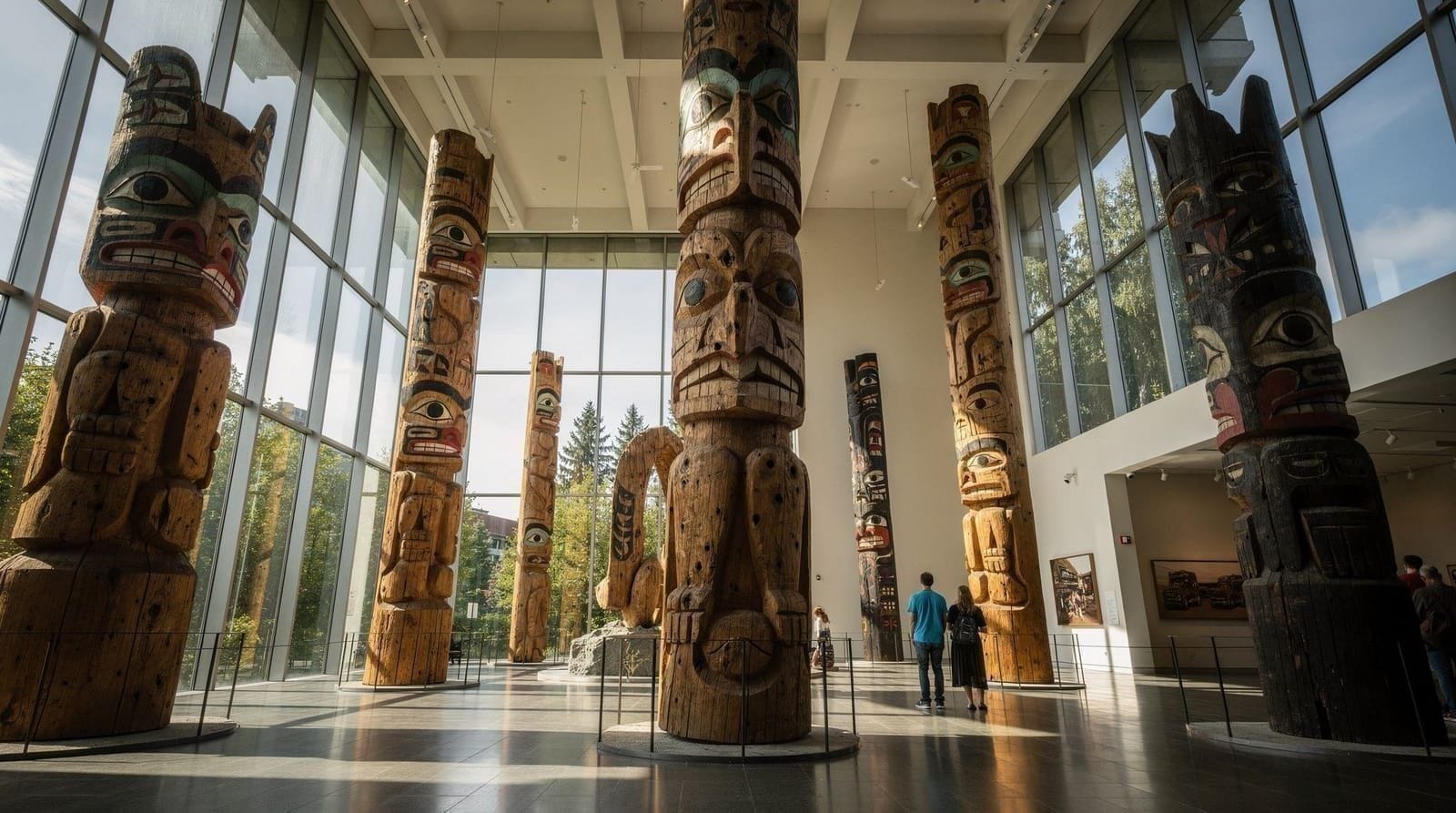
The gallery holds one of the largest collections of work by Emily Carr, one of Canada’s most significant early-20th-century painters, known for her bold depictions of British Columbia’s coastal landscapes and her documentation of Northwest Coast Indigenous villages and totem poles at a time when much of that material culture was under serious threat from government suppression and cultural disruption.
Carr’s work occupies a complicated position — a non-Indigenous artist whose paintings remain among the most widely reproduced visual records of the period’s Indigenous villages and totem poles, valuable historically but worth viewing with an awareness of that context rather than as a neutral documentary record. The gallery’s Carr holdings are deep enough to reward multiple visits, and rotating selections mean a repeat visitor will often see different works than on a previous trip.
Indigenous art within the gallery’s broader program
Alongside its historical and contemporary Canadian and international collections, the gallery has increasingly incorporated Indigenous art and artists into both its permanent displays and touring exhibitions in recent years, presenting contemporary Indigenous practice alongside — rather than separately from — the broader Canadian art narrative. This is a meaningfully different curatorial approach than treating Indigenous art as a specialized category confined to dedicated Indigenous-focused institutions like the Bill Reid Gallery or MOA, and visitors interested in seeing how a mainstream civic gallery is evolving its relationship with Indigenous art and artists will find this an interesting thread to follow across a visit.
Contemporary and rotating exhibitions
Beyond its historical holdings, the gallery runs an active program of contemporary and touring exhibitions, spanning Canadian and international artists across various media. These change throughout the year and often represent the more dynamic, unpredictable part of a visit — checking the current exhibition schedule before going is worth doing for visitors with a specific interest, since a major touring show can significantly change what’s on offer compared to a visit focused purely on the permanent Carr collection.
Francis Rattenbury and Vancouver’s architectural heritage
Rattenbury’s broader body of work across British Columbia is worth understanding as context for the gallery building specifically. Beyond the Vancouver courthouse and his more famous Victoria projects, Rattenbury was among the most prolific and influential architects working in the province during its early-20th-century growth period, and his buildings share a consistent Beaux-Arts grandeur intended to project institutional permanence and confidence in a young, rapidly growing province.
His personal life ended in scandal and tragedy — he was murdered in England in 1935 in a case that received significant tabloid attention at the time — a dramatic footnote that adds an unusual layer of historical intrigue to an otherwise straightforwardly architectural legacy, worth mentioning to anyone touring the building who appreciates a bit of history beyond bricks and columns.
The gallery’s evening and late-opening hours
Beyond standard daytime hours, the gallery periodically extends into the evening on specific nights, sometimes tied to a touring exhibition’s opening or a themed public program — worth checking the current schedule if a downtown day’s timing doesn’t naturally align with a daytime visit. An evening visit has its own distinct atmosphere, generally quieter than a weekend afternoon and sometimes paired with a talk, film screening or live music in the rotunda space, which changes the character of the visit meaningfully from a standard daytime walk-through of the permanent collection.
Getting there and admission
The gallery’s downtown location, facing Robson Square, puts it within easy walking distance of most downtown hotels and a short walk from the Bill Reid Gallery and the edge of Gastown. Admission runs in a moderate range for a major city gallery, with reduced rates for students and seniors, and many visitors combine it with the adjacent Robson Square plaza, which hosts occasional public events and an ice rink in winter.
How much time to budget
Most visitors spend 1.5 to 2.5 hours here, enough to see the Carr collection and a reasonable portion of whatever contemporary exhibition is running without rushing. Visitors with a particular interest in a specific touring exhibition should budget more time accordingly, since major shows can occupy significant additional gallery space beyond the permanent collection.
Combining with downtown sightseeing
Given its central location, the gallery works well as part of a broader downtown day. A Vancouver city highlights tour covering the downtown core often passes directly by or near the gallery, and visitors piecing together their own walking route can easily combine it with the Bill Reid Gallery, Robson Street shopping, and a walk toward Gastown or the waterfront.
For a different, more active way to cover the same ground, a half-day city highlights e-bike tour is a reasonable alternative for visitors who want to combine several downtown cultural stops with more active sightseeing in between.
The rotunda and public programs
Beyond the exhibition galleries themselves, the building’s dome and rotunda space periodically hosts talks, film screenings, and public programs tied to current exhibitions — worth checking the gallery’s schedule for during your visit dates if this kind of programming interests you, since it isn’t guaranteed to align with a standard walk-through visit. The gallery has also expanded its public-facing programming in recent years with family days, artist talks, and evening events that extend beyond the standard daytime gallery-visit format.
A note on the planned new building
The Vancouver Art Gallery has discussed and planned a move to a larger, purpose-built facility elsewhere downtown for some time, a project that has faced delays and funding challenges over the years. Visitors should check the gallery’s current location and status before finalizing plans, since a major institutional move, if it proceeds, would change both the location and likely the exhibition space significantly from what’s described here.
Comparing to the city’s other art and culture stops
Visitors deciding how to allocate limited downtown time between the Vancouver Art Gallery, the Bill Reid Gallery, and, for those willing to travel further, the Museum of Anthropology should think about focus: the Vancouver Art Gallery offers a broader survey of Canadian and international art including the significant Emily Carr holdings, the Bill Reid Gallery focuses tightly on Northwest Coast Indigenous art, and MOA offers the greatest depth and scale for Indigenous material culture specifically.
Visitors with a single afternoon downtown and broad art interests are well served by the Vancouver Art Gallery alone; those specifically prioritizing Indigenous art should weigh the Bill Reid Gallery or MOA more heavily instead.
The Vancouver photoconceptual movement
Beyond Emily Carr, the gallery has played a significant role in documenting and exhibiting the so-called Vancouver School of photoconceptual artists — Jeff Wall, Rodney Graham, Stan Douglas, and Ian Wallace among the most internationally recognized — whose large-scale staged photography and conceptual work emerged from the city starting in the 1970s and gained major international critical attention from the 1980s onward.
The gallery periodically features work connected to this movement in its rotating exhibitions, and visitors with an interest in contemporary photography or conceptual art should specifically check whether any current show touches on this locally significant artistic lineage, since it represents one of Vancouver’s most internationally influential contributions to contemporary art.
Family programs and accessibility
The gallery runs family-oriented programming at various points throughout the year, including guided activities and simplified exhibition materials aimed at younger visitors, worth checking for if traveling with children specifically interested in art rather than assuming a standard adult-paced gallery visit will hold their attention. The building is wheelchair accessible, with elevators connecting its various floors despite its heritage courthouse structure, though as with many converted historic buildings, some original architectural details create a slightly less streamlined accessible route than a purpose-built modern gallery would offer.
The gift shop and cafe
The gallery’s gift shop stocks art books, prints, and gallery-branded merchandise, along with some locally made design items, a reasonable stop for visitors wanting exhibition catalogues or art-related souvenirs distinct from the more craft-and-jewelry-focused shops at the Bill Reid Gallery or MOA. An on-site cafe offers a convenient lunch or coffee break option without leaving the building, useful for visitors planning to spend a full afternoon between the gallery and the adjacent Robson Square plaza.
Robson Square and the surrounding plaza
Immediately in front of and below the gallery, Robson Square is a multi-level public plaza that hosts a seasonal outdoor ice rink in winter, free to use with rental skates available, and various public events and markets throughout the year. It’s a natural extension of a gallery visit, worth a few extra minutes to explore even for visitors not planning to skate, particularly in winter when the rink and surrounding lights give the plaza a distinctly festive atmosphere connected to but separate from the gallery’s own programming.
Comparing admission costs
Relative to the Bill Reid Gallery’s lower admission and the Museum of Anthropology’s mid-range pricing, the Vancouver Art Gallery sits at the higher end of the city’s museum admission costs, reflecting its larger scale and more frequent major touring exhibitions. Visitors budgeting a downtown culture day across multiple stops should factor this in, and City of Vancouver library card holders or students should check for any current discount or free-admission programs, which shift periodically and can meaningfully reduce the cost for eligible visitors.
Best time to visit for smaller crowds
Weekday mornings, shortly after opening, tend to be the quietest time to visit, particularly outside of a major touring exhibition’s opening weeks, when attendance can spike considerably above the gallery’s typical baseline. Weekend afternoons, especially during a popular touring show, can get genuinely busy, and visitors specifically wanting a quieter, more contemplative experience of the Carr collection should aim for an off-peak weekday visit rather than a weekend afternoon.
Emily Carr’s complicated legacy in more depth
Carr’s paintings of Indigenous villages and totem poles were created during a period — roughly the 1910s through 1930s — when she travelled extensively along the BC coast documenting sites and structures she believed, incorrectly in many cases, were disappearing entirely. Her work is now understood as a valuable but partial and outsider’s record, filtered through her own artistic sensibility and the limited understanding of Indigenous culture common among non-Indigenous Canadians of her era, rather than a neutral ethnographic document.
Contemporary curation at the gallery increasingly contextualizes her work this way, pairing it with additional interpretive material or displaying it alongside Indigenous artists’ own work, a more responsible framing than treating Carr’s paintings as a standalone historical record. Visitors interested in this specific complexity should read the accompanying exhibition text closely rather than viewing the Carr collection purely for its aesthetic and technical qualities.
Photography policy
Photography without flash is generally permitted throughout most of the gallery’s permanent collection displays for personal use, though touring exhibitions frequently carry stricter no-photography rules due to loan agreements with the lending institutions or artists — a common practice for major galleries hosting borrowed work rather than a policy specific to this gallery. Checking posted signage at the entrance to each specific gallery space is the most reliable way to know current restrictions during any given visit, since policies can vary by exhibition.
The gallery within Vancouver’s broader museum landscape
Compared to Canada’s other major civic art galleries — the Art Gallery of Ontario in Toronto or the Montreal Museum of Fine Arts, for instance — the Vancouver Art Gallery is more modest in scale, a reflection partly of the building’s constrained heritage-courthouse footprint rather than the strength of its curatorial program or collection. This is part of the ongoing argument for the gallery’s long-discussed move to a larger, purpose-built facility, though as noted above, that project’s timeline and status should be checked directly before planning a visit around it. For now, the current courthouse building remains fully operational and, for most visitors, entirely adequate for a satisfying 1.5-to-2.5-hour visit.
Combining with a broader downtown museum day
Visitors with a full day dedicated to downtown culture might reasonably combine the Vancouver Art Gallery with the Bill Reid Gallery a few minutes’ walk away, and a stop at Canada Place or the waterfront to round out the day with some outdoor scenery after two indoor gallery visits. This kind of downtown museum loop works particularly well on a rainy day, when Vancouver’s more outdoor-focused attractions lose much of their appeal and the concentration of high-quality indoor cultural stops within a compact downtown radius becomes a genuine advantage — the rain guide covers other indoor options to round out a wet-weather downtown day.
Where this fits in a first Vancouver itinerary
The gallery’s central location and reliable indoor format make it a natural fit for day one of most first-time Vancouver plans, including the 3-day Vancouver plan and the more general first-time Vancouver guide, both of which treat a downtown morning or afternoon as the trip’s opening day. Visitors piecing together a single day of downtown sightseeing can also see how a gallery stop fits alongside Stanley Park and Gastown in the one-day sightseeing guide.
The Founders’ Wing and permanent collection galleries
Beyond the Carr holdings, the gallery’s permanent collection spans historical and contemporary Canadian art more broadly, along with a smaller but genuine international collection touching on European and Asian art movements. These permanent galleries rotate less frequently than the touring exhibition spaces, giving repeat visitors a reasonably stable core to return to even as the featured touring shows change several times a year. Visitors specifically interested in seeing the full breadth of the permanent collection, rather than just the Carr rooms and whatever major show is currently running, should budget extra time to walk through these quieter, less heavily trafficked gallery spaces.
Membership and repeat-visit value
For travelers spending an extended period in Vancouver, or those planning a return trip within the same year, the gallery offers an annual membership that pays for itself after a handful of visits and typically includes discounted or free entry to touring exhibition openings and members-only preview events. This is a niche option for most short-stay visitors, but worth knowing about for longer-term residents, students, or frequent Vancouver visitors who want to follow the gallery’s rotating program more closely than a single visit allows.
Comparing a self-guided visit to a docent tour
The gallery periodically offers docent-led tours at scheduled times, generally covering the Carr collection and a highlighted section of whatever contemporary exhibition is running, with considerably more curatorial context than the wall text alone provides. Self-guided visits work well too, particularly for visitors who prefer to spend disproportionate time in whichever section interests them most rather than following a fixed group pace. Checking the current tour schedule in advance is worth doing for visitors whose visit timing has some flexibility, since aligning with a scheduled docent tour meaningfully deepens the experience without any additional cost beyond standard admission.
Seasonal considerations
As a fully indoor institution, the gallery is a reliable option regardless of Vancouver’s weather, making it a natural choice for a rainy stretch of a trip when the city’s outdoor attractions lose much of their appeal. Winter visits pair particularly well with Robson Square’s seasonal ice rink immediately outside, giving visitors an easy way to combine an indoor cultural stop with a bit of outdoor seasonal activity in the same short walk, without needing to travel elsewhere in the city for either.
The honest verdict
The Vancouver Art Gallery earns its central place in most downtown itineraries — the Rattenbury-designed former courthouse is worth seeing in its own right, and the Emily Carr collection gives the gallery a genuine claim to national significance beyond its role as a general city art museum. It’s a reliable, weather-proof stop that fits easily into almost any downtown day, and visitors with even a passing interest in Canadian art or the building’s architectural history will find the visit worthwhile.
Visiting with teenagers versus younger children
Teenagers with any interest in art or photography generally engage well with the gallery on its own terms, particularly the Vancouver photoconceptual movement’s large-scale staged photography, which reads as more immediately striking to a teen audience than some of the historical Carr holdings.
Younger children, by contrast, do better with the gallery’s specific family programming days than an unstructured self-guided walk through the permanent collection, since a standard gallery pace doesn’t hold most younger kids’ attention for the full 1.5-to-2.5-hour visit adults typically budget. Checking the current family-days calendar before a visit with younger kids specifically is worth the extra step if art is meant to be a highlight rather than an afterthought squeezed between other downtown stops.
Buying tickets and skipping the line
Tickets are generally available at the door without a long wait outside of a major touring exhibition’s opening weeks, when a specific timed slot can sell out on a weekend afternoon. Booking online ahead removes that risk entirely and is worth doing if your visit is tied to a specific afternoon window between other downtown plans. Members and city library card holders should check for reciprocal or discounted entry before paying full price at the counter, since these programs shift periodically and aren’t always advertised prominently at the entrance.
A practical one-hour version for a tight schedule
Visitors with only an hour rather than a full afternoon should prioritize the Emily Carr galleries and skip the Founders’ Wing and a slower walk through the rotunda’s public program space — Carr’s work is the collection’s genuine claim to significance, and a focused hour there beats a rushed walk through everything. This compressed version pairs well with a quick loop of Robson Square outside, giving a sense of the building’s heritage architecture even without going deep on the contemporary exhibitions.
Top experiences
Bookable activities with verified prices and instant confirmation on GetYourGuide.