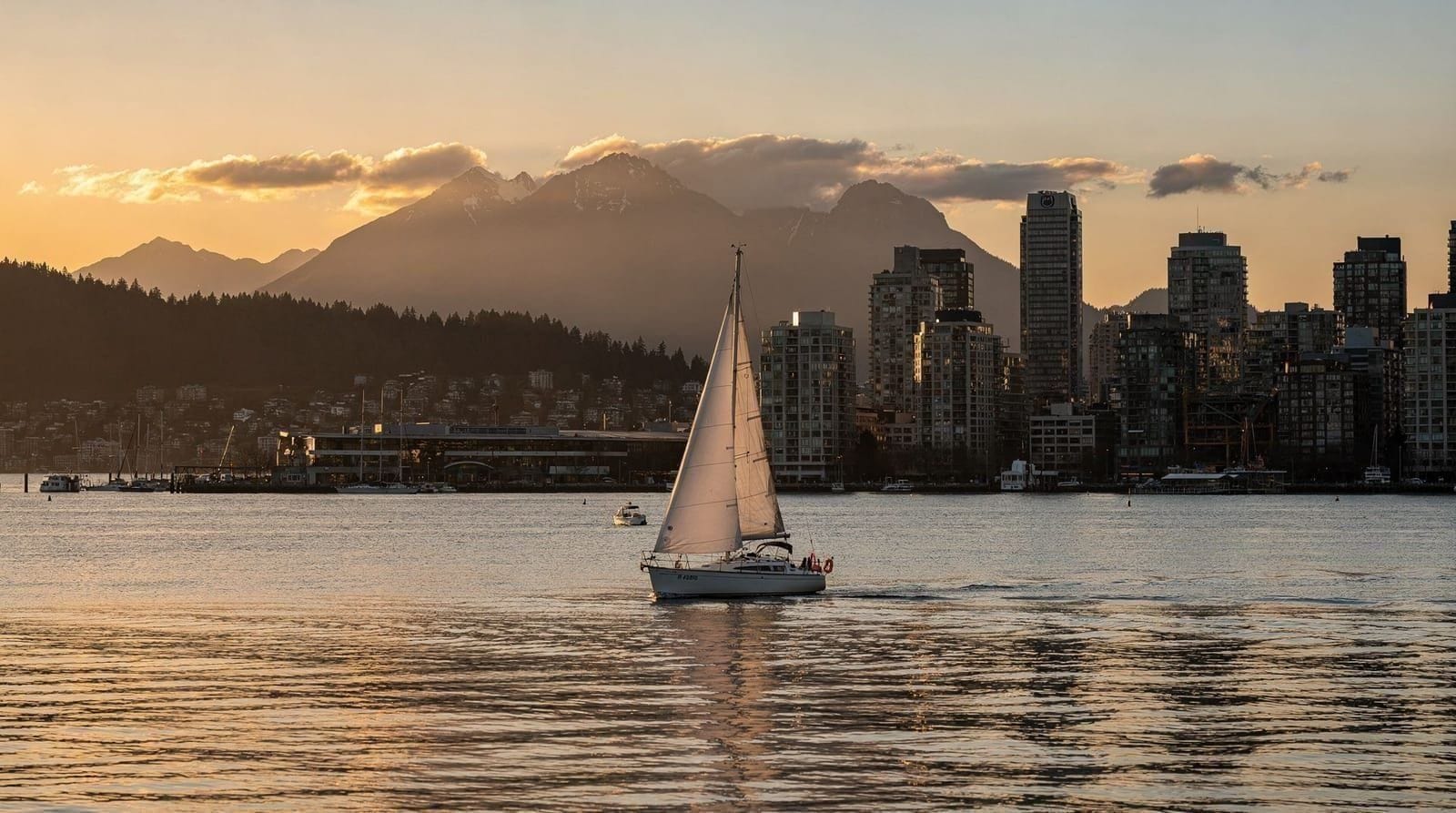
Kayaking False Creek and Granville Island
Kayaking Vancouver Tour
Is kayaking around Granville Island good for beginners?
Yes. False Creek, the waterway that wraps around Granville Island, is calm and sheltered from ocean swell and significant current, which makes it one of the most beginner-friendly places to kayak in the region. It's a genuinely different category of water from open coastal spots like Indian Arm.
False Creek, the inlet that wraps around Granville Island, is the calmest, most sheltered water covered anywhere in this site’s kayaking coverage — protected on most sides by shoreline and bridges, with none of the ocean swell or significant current that shapes paddling further out toward English Bay or up Indian Arm. That’s exactly why it’s the spot most often recommended to complete beginners, and why this guide focuses less on skill level and safety margins than the others in this cluster, and more on what you’ll actually see and how to build a good day around it.
| Where | False Creek, around Granville Island |
| Difficulty | Beginner-friendly, sheltered water |
| Best time | Mornings, roughly May-September |
| Duration | A couple of hours, guided or independent |
| Pairs well with | A Public Market lunch afterward |
A brief note on False Creek itself
False Creek isn’t actually a creek in the geological sense — it’s a saltwater inlet, a shallow arm of the harbour that cuts into the city between downtown and the neighbourhoods further south. Its shores were heavily industrial for much of Vancouver’s history, with sawmills and shipyards lining the water; Granville Island itself started as reclaimed industrial land before its transformation into the market and artisan hub it is today.
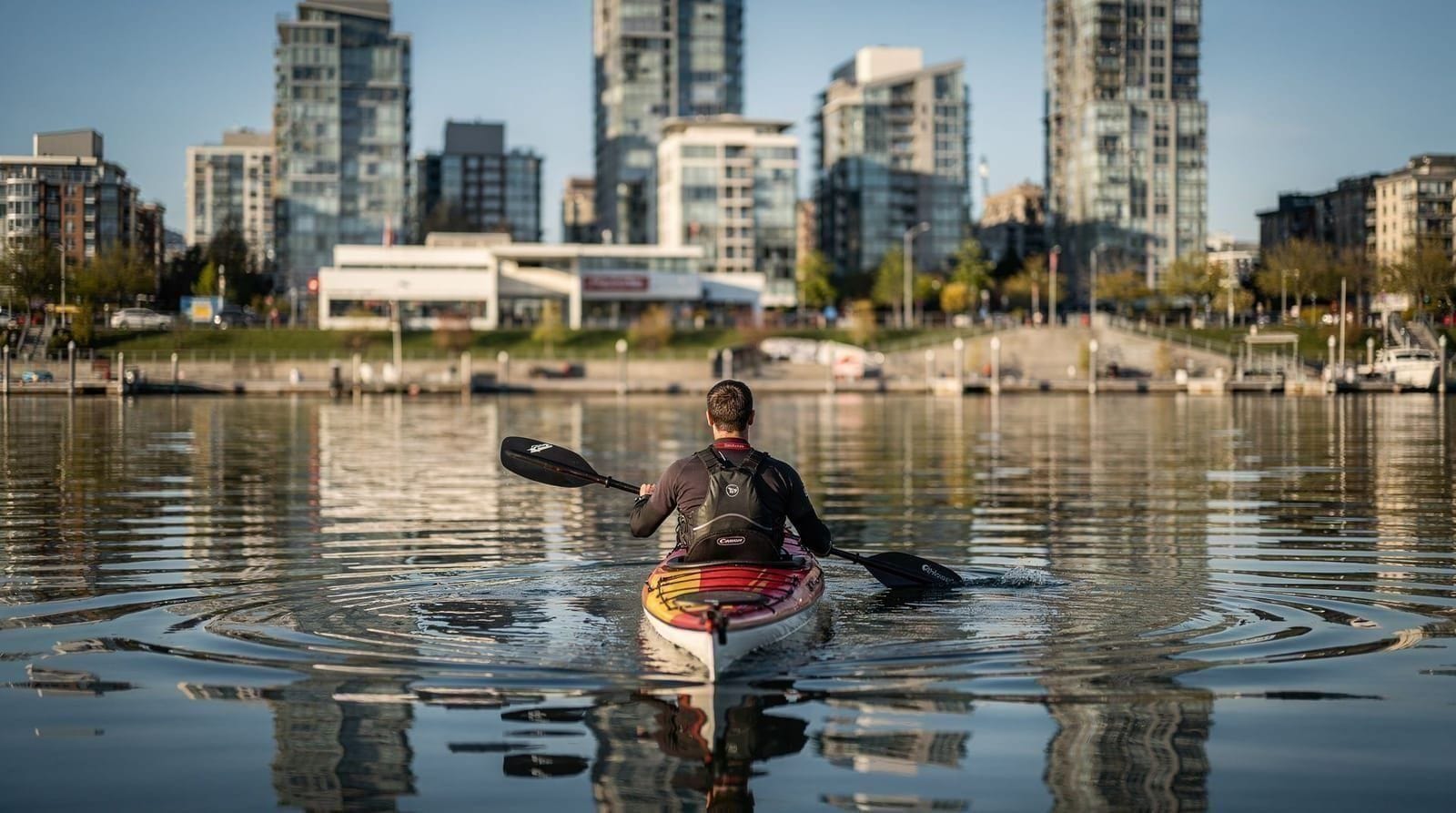
That industrial past is part of why the Creek now has such a mixed shoreline character from a kayak — glass residential towers, converted warehouses, working marinas, and the market building all within a single short paddle, a visible layering of the city’s history that’s easy to miss from land but obvious once you’re on the water looking at the shoreline from a low vantage point.
Why False Creek is different from the rest of this cluster
The other guides in this kayaking series spend real time on tides, wind, and cold-water risk, because those factors genuinely shape trips to Indian Arm or open water off Deep Cove. False Creek is a different category of water almost entirely. It’s an enclosed inlet rather than open coastline, so there’s no meaningful ocean swell to manage, and current within the Creek is minor compared to a tidal channel like the entrance to Indian Arm.
That doesn’t mean zero caution is required — it’s still real water, shared with other boat traffic, the Aquabus and False Creek Ferries among them, and the water itself stays cold year-round the way it does everywhere else on this coast — but the risk profile is meaningfully lower, which is the whole reason this spot works so well for first-time paddlers, families, and anyone easing into kayaking for the first time.
What you’ll paddle past
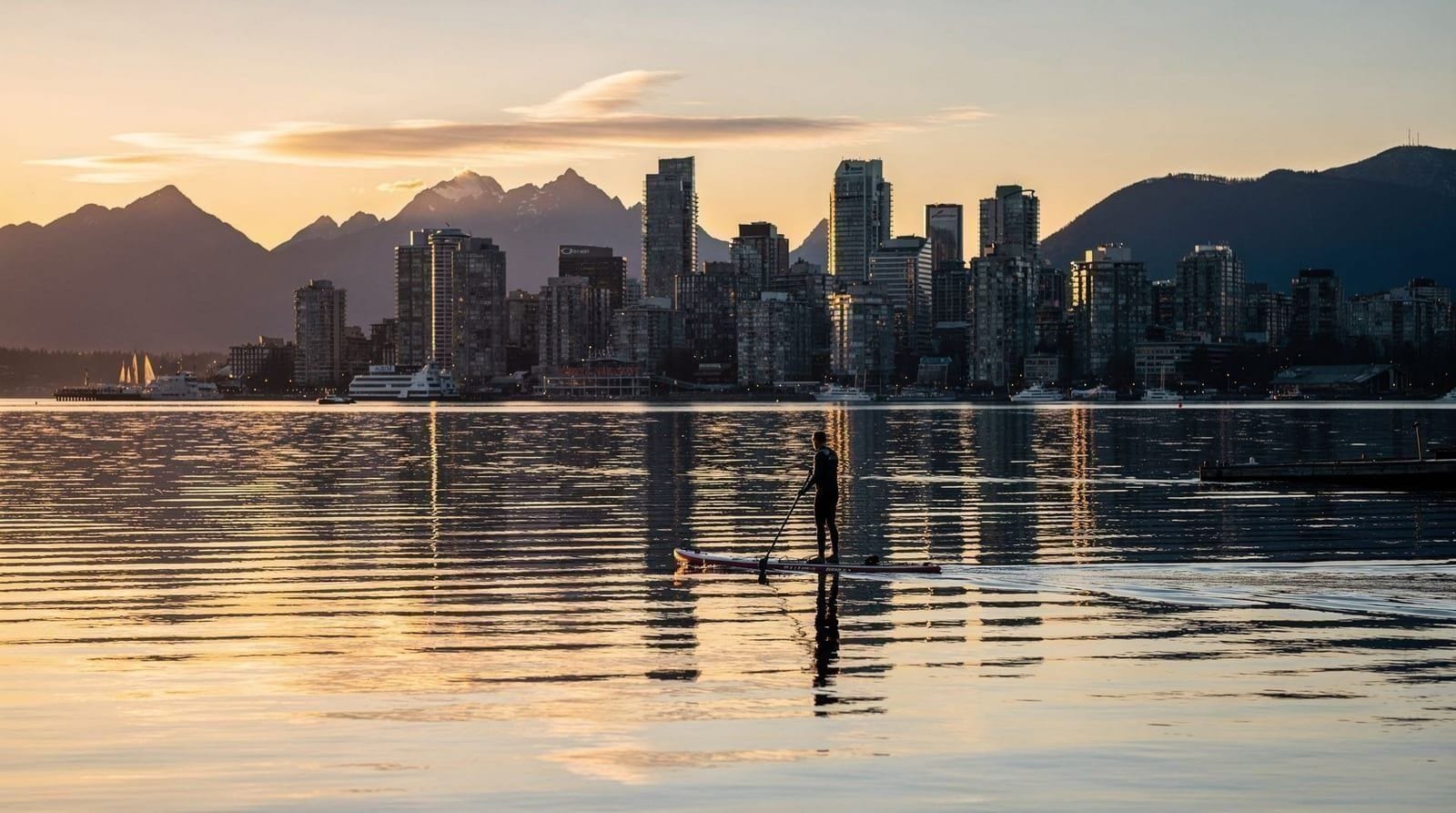
Part of the appeal here is that the view changes constantly over a short paddle, since False Creek is a compact body of water with a lot packed around its edges. Heading out from a launch point near Granville Island, you’ll get close-up views of the underside of the Granville Street Bridge, a genuinely different perspective than walking or driving over it. Continuing along the Creek, Science World’s geodesic dome marks the eastern end, a distinctive landmark visible from most of the water. The Cambie and Burrard Street bridges cross the Creek at other points, each offering the same shift in perspective — bridges most visitors only ever see from below on land now framing the sky from directly underneath.
Along the northern shore, Yaletown’s waterfront runs past converted warehouse buildings and a walkway that’s popular with joggers and cyclists, visible from the water as a fairly dense strip of glass towers and restored brick. Granville Island itself, when you loop back around it, shows a different face from the water than from its market-side streets — working marina, houseboats, and the industrial-turned-artisan character of the island’s edges.
Sharing the water: boat traffic and dragon boat teams
False Creek is busy water by regional standards, even though it’s calm. Aquabus and False Creek Ferries boats cross regularly on set routes, and the Creek is also a popular practice ground for dragon boat teams, a genuinely common sight on evenings and weekends given Vancouver’s active dragon boat racing scene.
None of this makes the water dangerous the way open-water boat traffic near Indian Arm can be — everyone is moving at modest speed in a contained area — but it does mean staying reasonably aware of your surroundings rather than assuming empty water in every direction. Guided tours account for this as a matter of course, routing around the busier crossing points; if you’re paddling independently, keeping an eye out near the Aquabus docks and giving dragon boat crews a wide berth is basic courtesy as much as safety.
Best time of day and season to paddle
Mornings tend to be the calmest and quietest time to paddle False Creek, with less boat traffic and, in summer, more comfortable temperatures before the afternoon sun is at its strongest. Weekday paddles are noticeably less busy than weekends, when both the water and the market fill up. Season-wise, the practical window mirrors the rest of the region’s kayaking — roughly May through September for the most reliable weather and the fullest schedule of guided tour departures, though False Creek’s sheltered nature means it’s a more forgiving option than open water even on a cooler or breezier shoulder-season day.
Kayaking vs. the Aquabus: two ways to see the same water
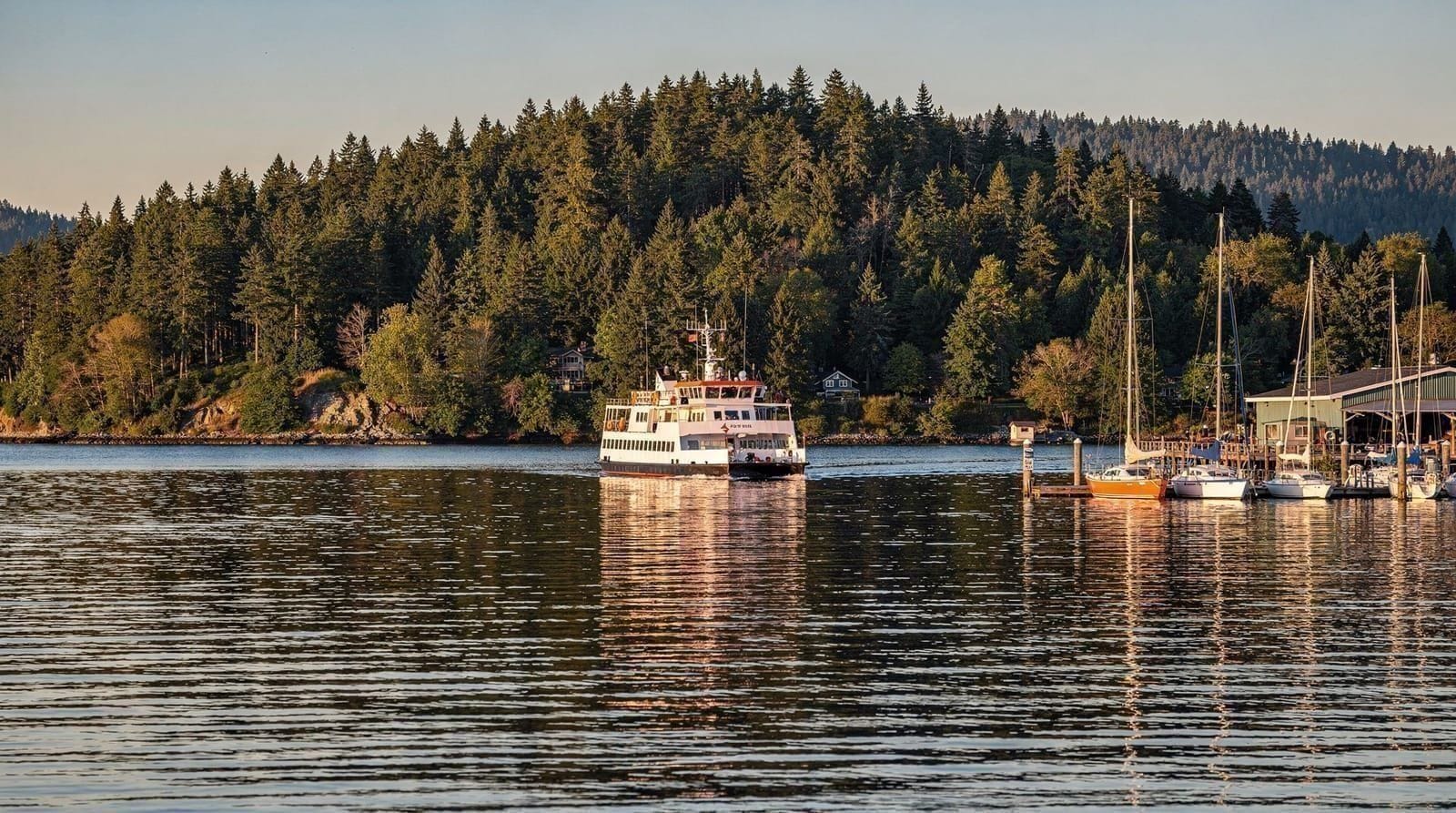
Granville Island and the surrounding False Creek shoreline are already served by the Aquabus and False Creek Ferries, small passenger boats that shuttle between docks around the Creek for a few minutes and a modest fare. It’s worth being direct about how kayaking compares, since both are genuinely reasonable ways to experience the same stretch of water.
The Aquabus and ferries are faster, require no physical effort, and make sense as point-to-point transport — getting from Yaletown to Granville Island, for instance, without walking the long way around or taking a bus. They’re not really a scenic experience in their own right so much as functional transit that happens to cross nice water.
Kayaking is slower, requires some physical effort, and costs more for a comparable amount of time, but it puts you at water level, lets you set your own route rather than following a fixed dock-to-dock line, and turns the crossing itself into the activity rather than a means to an end. If the goal is simply to get from one side of the Creek to the other, the Aquabus is the more sensible choice. If the goal is to spend time actually on the water, paddling is the better experience, and it’s the option that lets you slow down and notice details — the bridges from underneath, the houseboats along the shore — that a five-minute ferry hop doesn’t allow.
Guided tours on False Creek
The Vancouver kayaking tour and the smooth classic kayak tour both cover sheltered water in this general area, with the smooth classic option in particular built around complete beginners — a short on-shore briefing on paddle strokes and basic safety, followed by an unhurried couple of hours on calm water.
Either is a reasonable starting point if you’ve never kayaked before, and the two are worth comparing directly on departure time and exact route if you’re choosing between them, since both deliver a similar low-stakes introduction to paddling. For the fuller picture of how these tours compare to the wildlife-focused seal and snorkel combo options elsewhere in the region, see the main kayaking Vancouver guide.
Renting independently around False Creek
Because the water here is so sheltered, independent rental is a genuinely reasonable option for anyone with even modest paddling experience, more so than it would be for open coastal spots. Rental operators near the False Creek shoreline let you set your own pace and route within the inlet rather than following a guide’s schedule, which suits visitors who already know the basics and just want time on calm water without a fixed itinerary. It’s still worth checking what’s included — paddle, life jacket, and any instruction — and confirming the rental window before committing, since return times matter more than they might seem to on water this contained.
Photography and what to bring a camera for
The bridges are the main draw for anyone bringing a camera along, since the underside perspective is genuinely different from anything you’d capture on land — the Granville Street Bridge in particular has a scale that’s easy to underestimate until you’re paddling directly beneath its support pillars.
Late afternoon light tends to catch the glass towers along the Yaletown shoreline well, and early morning offers calmer water with fewer other boats or paddlers in the frame if a clean, uncluttered shot matters. A waterproof case or a dedicated action camera is the more sensible choice over a phone held loosely in a kayak, given how easily a splash or a sudden brace stroke can send an unsecured device into the water — and unlike a lost hat, a phone in False Creek isn’t coming back.
Pairing your paddle with the market
One of the more natural full-morning or full-afternoon plans in this part of the city is to paddle first, then walk into the Granville Island Public Market once you’re back on land — the market sits right at the water’s edge, so the transition from kayak to lunch is about as short as it gets. Paddling earlier in the day tends to mean calmer water and a quieter market before the midday crowds build, which is a reasonable reason to front-load the water time rather than treat it as an afternoon add-on.
If navigating more than 50 market vendors on your own sounds like more effort than it’s worth, a Granville Island market tour with tastings is worth booking for the market half of the day — it’s worth being clear that this is a food and market experience, not a paddling product, so think of it as a “pair your paddle with this” suggestion rather than something that includes kayaking itself. Together, a morning paddle and an afternoon guided market visit make for a full, varied day without much wasted transit time, since both halves happen within a short walk of each other.
Families and kids on False Creek
Because the water here is calm and the paddling routes stay close to shore, False Creek is one of the more workable kayaking options in the region for families with kids, provided they’re comfortable in a life jacket and able to sit reasonably still for the length of a tour or rental. Most guided tours set a minimum age for participants, commonly somewhere around 6 to 8 years old, and two-person kayaks make it straightforward for a parent to paddle with a child rather than requiring the child to manage a boat alone. It’s still worth setting expectations honestly: even calm water requires some patience and cooperation from a young paddler, and a bored or restless child in a kayak is a harder problem to solve mid-paddle than on land.
What to wear and bring for a False Creek paddle
The gear requirements here are a notch lighter than for open-water or wildlife-focused trips elsewhere in this cluster, since you’re less likely to get thoroughly soaked and the water itself, while still cold, isn’t the same immersion risk as more exposed coastline. Comfortable clothing you don’t mind getting a little wet, a change of dry clothes for afterward, sun protection, and secure footwear rather than sandals are the basics. Guided tours supply the kayak, paddle, spray skirt, and life jacket; independent renters should confirm the same before setting out. A dry bag or a waterproof phone case is still worth having, since a splash from a passing wake is entirely possible even on calm water.
Getting there and back
Granville Island itself is reachable by Aquabus or False Creek Ferries from Yaletown and downtown docks, or by a flat, roughly 20-minute walk across the Granville Street Bridge if you’d rather skip the water crossing beforehand and save your paddling for the guided tour or rental itself. Parking on the island is limited and time-restricted, so arriving without a car is the more straightforward plan regardless of whether kayaking is part of your day. The Granville Island destination guide covers the market, the brewery, and the artisan studios in more detail if you’re building out a fuller day beyond just the water.
What it typically costs
As with the rest of the region’s guided kayaking, False Creek tours built around a couple of hours on sheltered water tend to sit at the more affordable end of the price spectrum for guided water activities in Vancouver, reflecting the shorter duration and lack of a boat transfer or extra equipment like wetsuits. Independent rental by the hour is generally the cheapest way to get on the water here, and it’s a genuinely fair option given how sheltered and forgiving the water is, unlike the caution around independent rental urged elsewhere in this cluster for open coastal spots. Pairing the paddle with a market tour adds a separate cost on top, worth budgeting for as two distinct activities rather than a single bundled experience.
How this compares to the rest of the region’s paddling
False Creek is deliberately the easiest, most urban entry in this kayaking cluster, and it’s worth choosing with that framing in mind. If dramatic natural scenery is the priority over convenience and calm water, Indian Arm delivers that at the cost of far more planning and, for most visitors, a guided boat tour rather than a self-paddle. Deep Cove sits in between — still an easy, beginner-friendly launch point, but with open water and direct access to the fjord for anyone who wants to go further.
Bowen Island is a different kind of day out entirely, a ferry crossing to an island village with its own casual kayak rentals rather than a dedicated paddling destination. For a broader look at how kayaking stacks up against other ways to get on the water around Vancouver, including sailing and paddleboarding, the main kayaking Vancouver guide ties the whole cluster together.
For most visitors with limited time and no paddling background, though, False Creek around Granville Island remains the most straightforward starting point in the region — calm water, close to downtown, easy to combine with a market lunch, and about as forgiving an introduction to kayaking as exists anywhere near the city.
If this paddle turns out to be the first time kayaking clicks for you, it’s worth treating it as a starting point rather than the ceiling of what’s available nearby. The skills and comfort built on an hour of calm water here transfer directly to the more open, more demanding spots further out — and the main kayaking Vancouver guide is the place to figure out what a reasonable next step looks like once False Creek starts to feel too easy.
There’s no real downside to starting here even if the more dramatic destinations are the eventual goal. A calm, low-consequence hour on False Creek is a genuinely useful way to test whether kayaking itself is enjoyable before spending more time and money on a longer trip further afield, and it costs relatively little in either time or money to find out.
Frequently asked questions — Kayaking False Creek and Granville Island
Do I need kayaking experience to paddle around Granville Island?
No. False Creek's sheltered, protected water is specifically why guided tours in this area are built for complete beginners, with basic on-shore instruction before you launch and calm conditions throughout the paddle.What will I see kayaking around Granville Island?
Expect close-up views of the Granville, Cambie, and Burrard Street bridges, Science World's geodesic dome at the eastern end of False Creek, the Yaletown waterfront, and Granville Island's own marina and market building from the water rather than the shore.Is kayaking or the Aquabus a better way to see False Creek?
They show you the same water from different angles. The Aquabus and False Creek Ferries are faster, cheaper for a single crossing, and require no effort, useful for point-to-point transport. Kayaking is slower, more active, and lets you linger anywhere on the water rather than following a fixed route between docks — better if the paddling itself, not just getting across, is the point.Can I combine kayaking with a Granville Island market visit?
Yes, and it's a natural pairing — paddle in the morning while the water and market are quieter, then walk into the Public Market for lunch once you're back on land. A guided market tour with tastings is a good option for the market half if you'd rather not navigate more than 50 vendors on your own.
Top experiences
Bookable activities with verified prices and instant confirmation on GetYourGuide.