Rainforest walks on the North Shore
Vancouver: Capilano Suspension Bridge Park Ticket
- Free cancellation
Where are the best rainforest walks near Vancouver?
The North Shore — North Vancouver and West Vancouver — has the region's most accessible temperate rainforest walking, concentrated around Lynn Canyon, Capilano's forest trails beyond the suspension bridge, and Lighthouse Park's old-growth Douglas fir. All are within 20–30 minutes of downtown Vancouver.
Vancouver sits at the southern edge of the Pacific temperate rainforest, one of the rarest forest biomes on the planet, and you don’t have to drive far to walk through it. The North Shore — the band of North Vancouver and West Vancouver on the far side of Burrard Inlet from downtown — holds the most accessible concentration of it: western red cedar and Douglas fir canopies, sword fern understory, moss-covered nurse logs, and creeks running through steep-sided canyons carved by glacial meltwater. This guide pulls together the main rainforest walking options across the North Shore so you can pick the one that matches how much time and effort you’ve got.
| Where | North and West Vancouver, 20–30 min from downtown |
| Cost | Free (Lynn Canyon, Lighthouse Park); Capilano charges admission |
| Time needed | 1–3 hours per stop |
| Best time | Year-round; driest June–September, muddy October–May |
| Best for solitude | Lighthouse Park |
What makes this a temperate rainforest, not just a forest
What makes this a temperate rainforest, not just a forest
The Pacific temperate rainforest gets over 1,500 mm of rain a year in this area (some North Shore mountain slopes see considerably more), which is what separates it ecologically from a typical city park’s tree cover. The dominant species — western red cedar, western hemlock, and Douglas fir — grow to enormous size in the wet, mild climate, with old-growth specimens on the North Shore regularly exceeding 60–70 metres in height and, in a few protected pockets, several centuries in age.
The forest floor tells the story just as clearly: thick sword fern beds, moss coating every horizontal surface, and “nurse logs” — fallen trees that host new seedlings growing directly out of their decaying trunks, a distinctive rainforest regeneration pattern you won’t see in drier forest types.
Banana slugs are the other giveaway. These bright yellow-green slugs, some reaching 15–20 cm, are a genuine rainforest indicator species and turn up reliably on damp trails after rain — kids in particular tend to find them the highlight of a walk here, and they’re harmless to observe (just don’t handle them, since their mucus is genuinely difficult to wash off and they’re sensitive to skin oils and salts).
Lynn Canyon: the free suspension bridge alternative
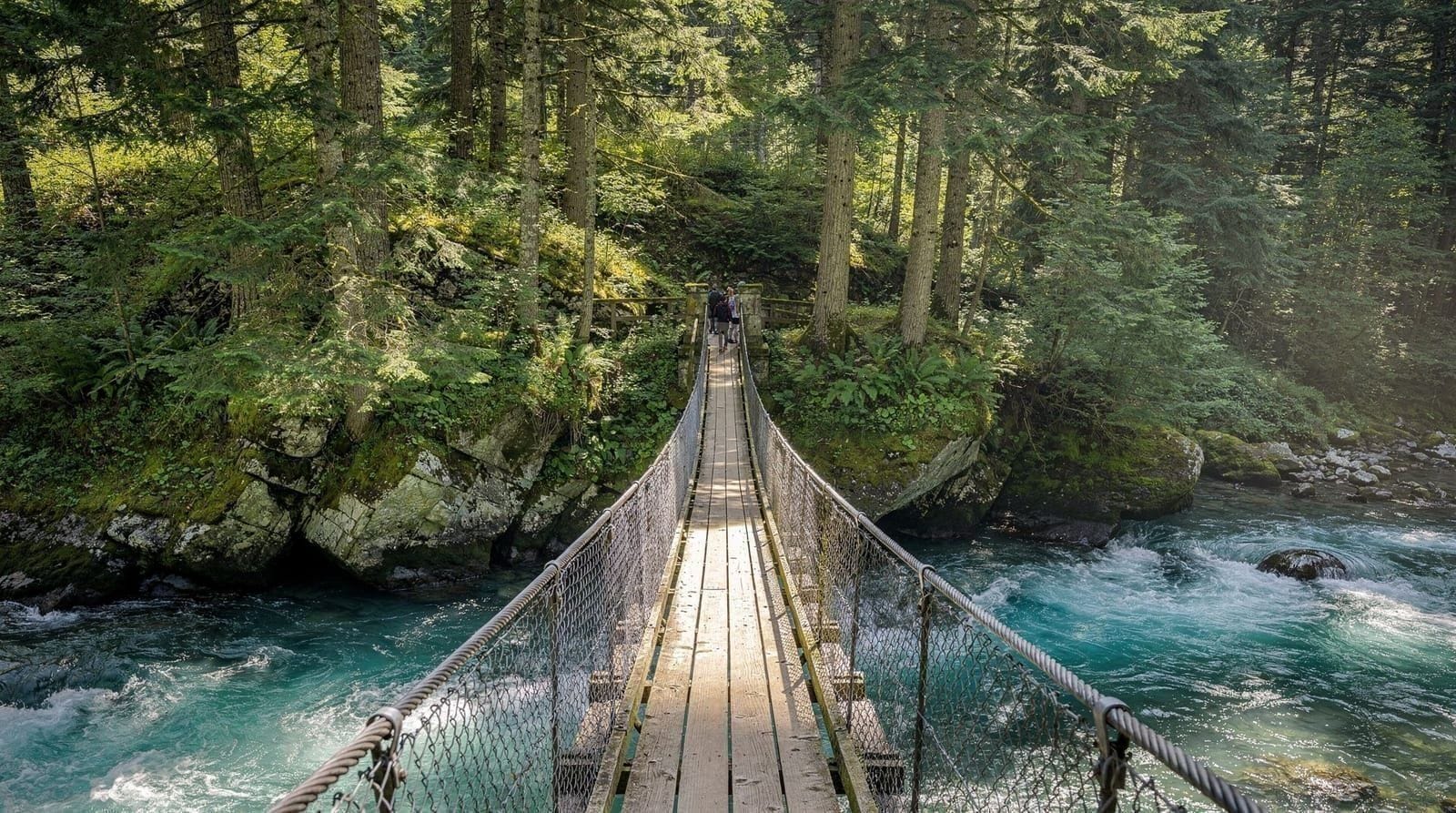
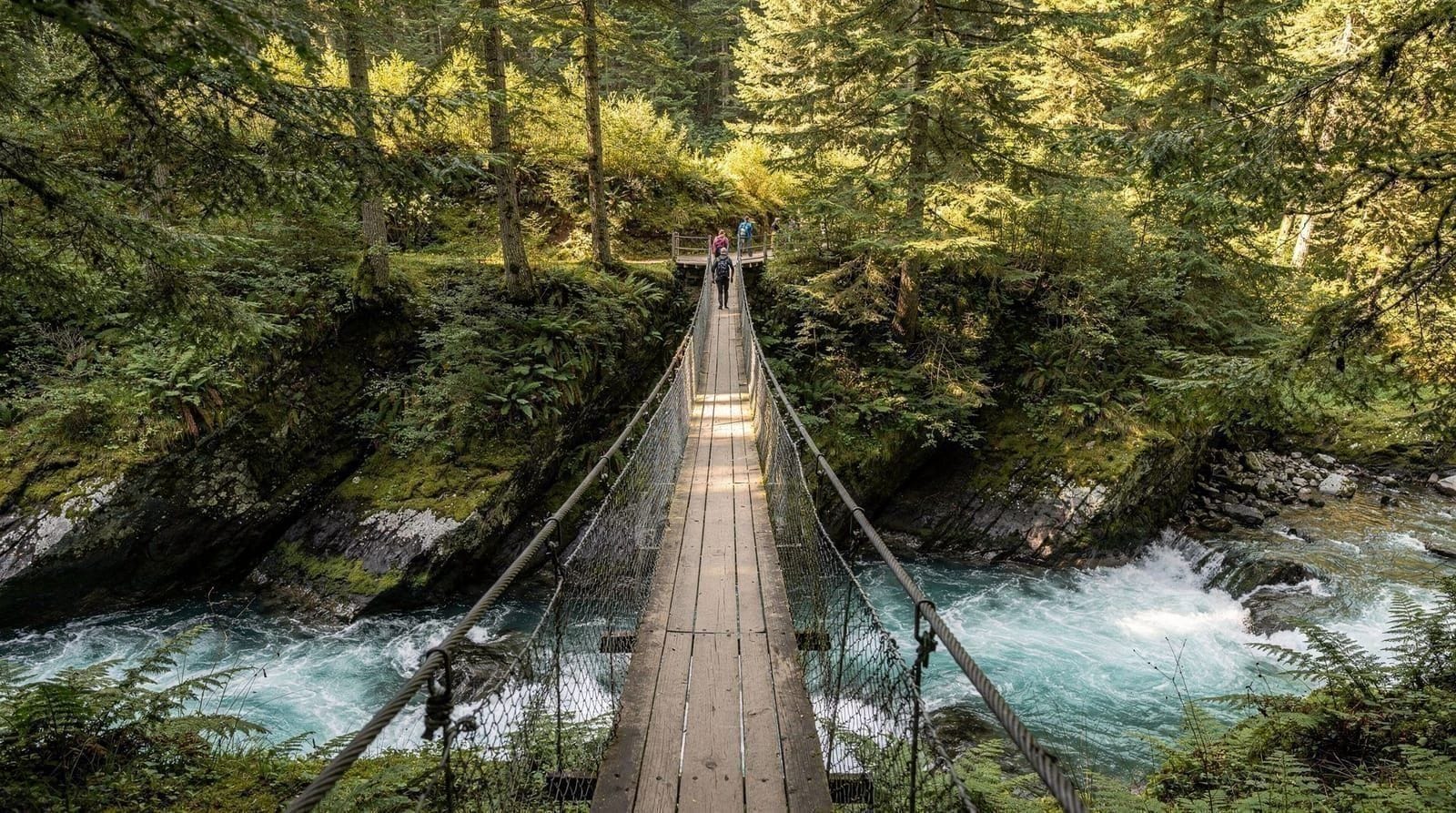
Lynn Canyon Park is the most-visited rainforest destination on the North Shore, largely because it offers a free suspension bridge over a genuine canyon — a direct, no-cost alternative to the paid Capilano bridge across town. The 30 Foot Pool and Twin Falls areas below the bridge show the canyon-carving power of Lynn Creek directly, and several loop trail options (Baden-Powell Trail sections connect through here) let you extend a visit well past the headline bridge if you want more forest time.
It gets busy — this is not a hidden spot, and parking at the small lot fills early on summer weekends — but it remains free, which for budget-conscious travelers or repeat visits makes it the default rainforest stop on the North Shore. Full detail is in our Lynn Canyon guide, and the direct comparison against Capilano is covered in Capilano vs. Lynn Canyon.
Capilano: forest trails beyond the bridge
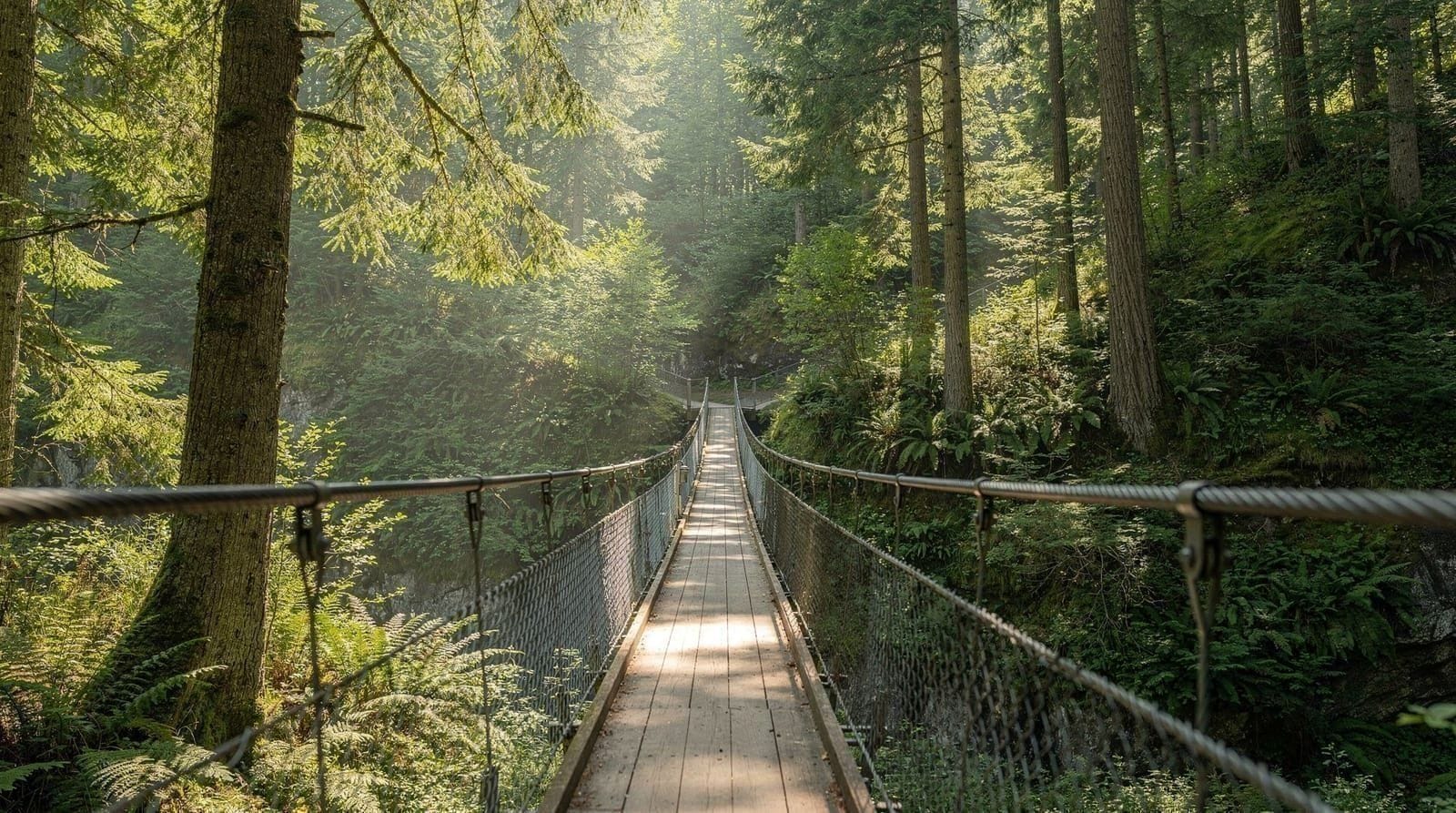
Capilano Suspension Bridge Park is best known for its 137-metre suspension bridge, but the paid admission also covers a set of forest trails that get overlooked by visitors who cross the bridge, walk the treetop Cliffwalk, and leave. The Capilano River Regional Park trails adjacent to the private attraction — some of which are free, separate from the paid bridge park — follow the river through genuine old-growth remnants and give a longer, quieter rainforest walk than the bridge park’s compact, heavily trafficked core. If you’re paying for admission anyway, budgeting an extra 30–45 minutes for these connecting trails is worth it before or after the bridge crossing itself.
Capilano and Grouse Mountain sit close enough together that a combined day tour covering both is a reasonable option for visitors without a car, particularly cruise passengers with a single day on the North Shore who want both the rainforest walk and an alpine summit in one outing.
Lighthouse Park: the old-growth outlier
Where Lynn Canyon and most of Capilano’s surrounding forest are second-growth (regrown after historical logging), Lighthouse Park in West Vancouver is a genuine exception — 75 hectares that were never logged, with Douglas firs exceeding 500 years old. It’s a different kind of rainforest experience: less dramatic canyon scenery, more the sheer scale and age of undisturbed old growth, ending at rocky Pacific shoreline rather than a river gorge. It’s also free and considerably quieter than Lynn Canyon on any given day, since it’s further from the main North Vancouver tourist corridor and less known.
Quarry Rock and the Deep Cove forest
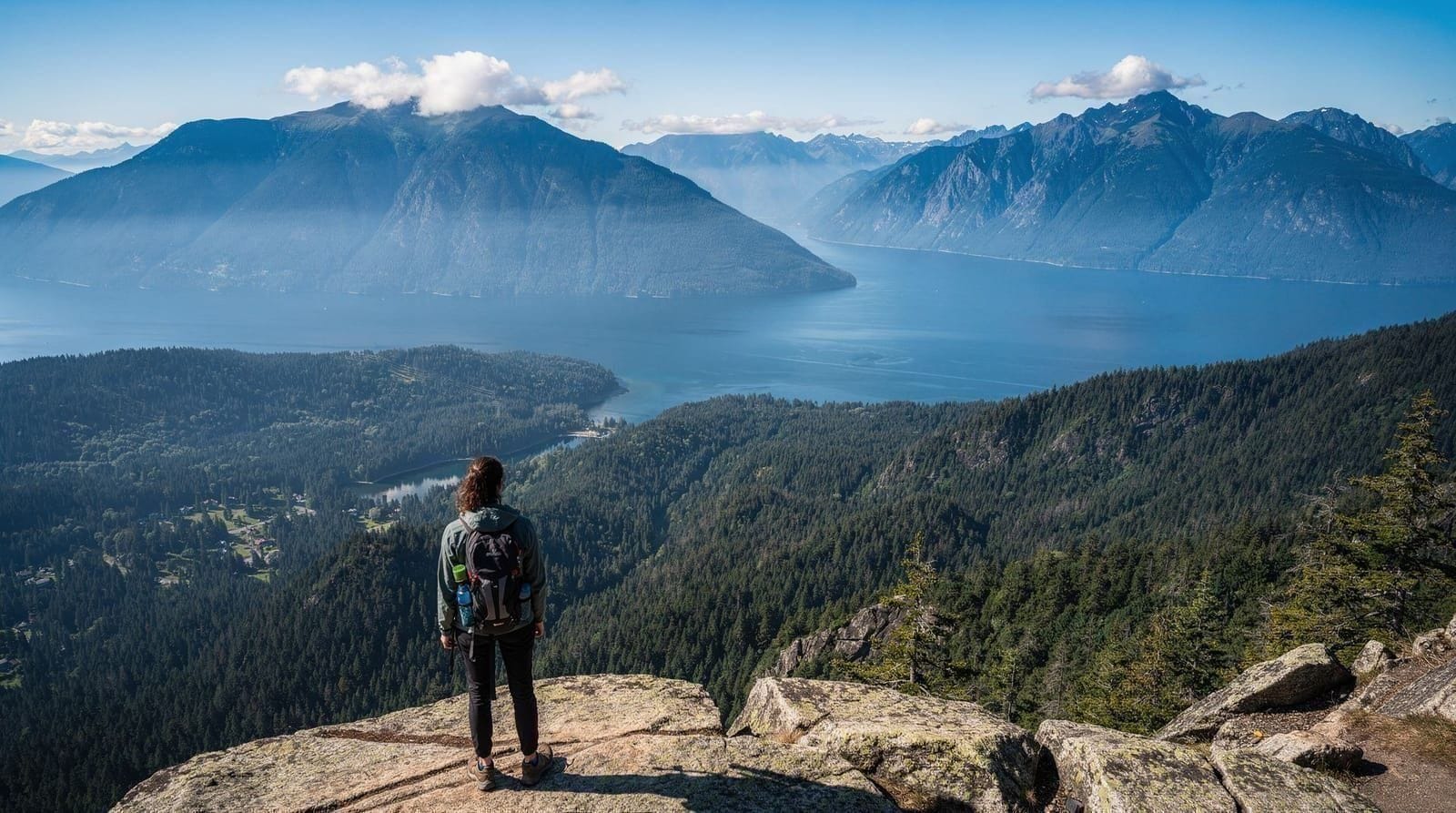
The trail to Quarry Rock in Deep Cove runs through a similar rainforest corridor before opening onto its well-known viewpoint over Indian Arm. It’s shorter and steeper than a full Lynn Canyon loop, and the payoff is a fjord viewpoint rather than canyon or old-growth scenery specifically, but it belongs in the same category of North Shore forest walking and pairs naturally with a Deep Cove visit if you’re already in that part of North Vancouver.
Pacific Spirit Park: the city-side comparison
Worth mentioning briefly as a contrast: Pacific Spirit Park near UBC, on the Vancouver side of the water rather than the North Shore, covers similar second-growth forest terrain but without the elevation change, canyons, or old growth that define the North Shore walks above.
It’s flatter, easier, and closer for anyone staying downtown or near UBC, but it doesn’t have the dramatic canyon-and-waterfall character that makes Lynn Canyon or Capilano distinct destinations in their own right. If your priority is genuine rainforest drama — suspension bridges, canyon walls, waterfalls — the North Shore is the better use of your time; if you just want an easy, quiet forest walk without crossing the water, Pacific Spirit Park is the more convenient option.
The wildlife you’ll encounter beyond banana slugs
Beyond the banana slugs, North Shore rainforest trails support a genuinely diverse set of species worth watching for. Douglas squirrels — smaller and darker than the introduced grey squirrels common in city parks — are common and vocal, often announcing a hiker’s approach with a sharp chattering call before you spot them. Pacific tree frogs turn up around creek edges and are more often heard than seen, their distinctive high-pitched call a common soundtrack on damp evenings. Pileated woodpeckers and varied thrush are among the more distinctive birds in these forests, the latter’s single-note, almost mechanical call being one of the more recognizable rainforest sounds once you learn to pick it out.
Black bears do range through North Shore forest, including areas close to trailheads, though sightings on the busier trails like Lynn Canyon are uncommon — standard bear-country practice (making some noise, not hiking with headphones in both ears, keeping food secured) applies throughout the region regardless of how populated a given trail feels.
Indigenous stewardship of these forests
The forests of the North Shore sit within the traditional and unceded territories of the Squamish, Tsleil-Waututh, and Musqueam nations, whose relationships with these lands and waters predate the region’s parks and trail systems by thousands of years. Western red cedar in particular held (and continues to hold) deep cultural and practical significance — used for canoes, longhouses, clothing, and rope, among many other applications — and is often referred to as the “tree of life” in Coast Salish culture for the breadth of its uses.
Interpretive signage at some North Shore parks, including sections of Capilano and Lynn Canyon, touches on this history, though it’s worth seeking out beyond the signage if you want a fuller picture — several Indigenous-led tour operators and cultural centres in the Vancouver area offer deeper context than a typical self-guided walk provides.
What to wear and bring
A minimal but genuinely useful packing list for any of these walks: footwear with real tread (trail runners or light hiking shoes are sufficient for all of the walks described here — none require heavy mountaineering boots), a light rain shell given how quickly North Shore weather can shift even on a forecast-clear day, and water, since none of these parks have reliable drinking fountains along the trail itself.
A phone with offline maps downloaded is a reasonable precaution, since cell coverage is inconsistent in canyon terrain specifically. None of the walks covered here require technical gear, poles, or specialized clothing — this is accessible rainforest walking, not backcountry mountaineering, and the barrier to entry is genuinely low if you show up with reasonable footwear and a rain layer.
Guided versus self-guided
All of the walks in this guide are entirely walkable without a guide — trails are marked, well-trodden, and (with the exception of some interior Pacific Spirit Park junctions) hard to get seriously lost on. That said, a guided visit adds real value if you want the ecological and cultural context explained rather than picked up from scattered signage, or if you’re short on time and want an efficient, curated version of the highlights rather than figuring out routing yourself.
Combined day tours covering Capilano and Grouse Mountain, in particular, are popular with cruise passengers and visitors on tight schedules who want the rainforest experience without spending a full day working out North Shore bus routes and trail junctions on their own.
Kids, dogs, and accessibility
Lynn Canyon’s main loop and Capilano’s core paths are both manageable for families with school-age children, though none of these parks are stroller-friendly beyond their most paved sections — root systems and uneven ground are a constant throughout North Shore rainforest terrain. Dogs are permitted on leash at Lynn Canyon and in the free sections of Capilano River Regional Park (not within the paid Capilano Suspension Bridge Park itself, where pets are generally not allowed — check current park rules before assuming otherwise).
None of these trails are wheelchair accessible in any meaningful sense; the terrain, root systems, and in Lynn Canyon’s case genuine elevation change rule that out, and travelers with mobility considerations are better served by paved options elsewhere on this site, like the Stanley Park seawall.
Seasonal considerations
All of these trails get wet and can get genuinely slippery from roughly October through May, when the bulk of the region’s rain falls. Roots, boardwalks, and rock surfaces near creeks and waterfalls turn slick fast, and every North Shore rainforest trail has some version of this hazard — Lynn Canyon’s rock ledges near the pools are a particular known spot for slips. Waterproof footwear with real tread makes a bigger difference here than almost anywhere else on a Vancouver itinerary. Summer (June–September) brings dry trails and the best conditions for casual walking, but also the biggest crowds at Lynn Canyon and Capilano specifically; weekday mornings are consistently the quietest time across all of these locations.
Mud is a near-constant companion outside summer — even well-maintained trails develop soft, muddy sections after sustained rain, and it’s worth accepting that shoes will get dirty rather than trying to route around every puddle. None of these walks require technical gear, but casual footwear (sandals, thin-soled sneakers) genuinely struggles on wet root systems and rock.
The canopy walkway experience: what sets Capilano apart
Beyond the ground-level forest trails common to all of these parks, Capilano offers something the others don’t: a genuine elevated canopy walk. The Cliffwalk, a cantilevered walkway bolted directly into a granite cliff face above the Capilano River, and the Treetops Adventure, a series of suspension bridges strung between old-growth trees roughly 30 metres above the forest floor, both put visitors inside the forest canopy rather than looking up at it from ground level.
It’s a meaningfully different way of experiencing rainforest structure — seeing how the canopy layers stack, how epiphytic mosses and ferns grow directly on tree branches rather than only at ground level — and it’s the clearest reason Capilano’s paid admission includes value beyond simply crossing the main suspension bridge and turning around.
How the canyon geology shapes the Lynn Canyon and Capilano experience
Both Lynn Canyon and the Capilano River gorge owe their dramatic terrain to the same broad geological process: fast-moving glacial meltwater cutting through granite and volcanic bedrock over thousands of years, leaving steep-walled canyons with pools, waterfalls, and exposed rock faces that contrast sharply with the flatter, gentler terrain at Pacific Spirit Park or the coastal bluffs at Lighthouse Park.
This is worth understanding because it explains a lot about what each destination offers: canyon terrain delivers dramatic verticality and moving water at the cost of some accessibility (stairs, exposed rock, real elevation change), while the flatter forests deliver easier, more relaxed walking without the same visual drama. Neither is objectively better — it depends on what kind of experience you’re after on a given day of your trip.
A note on crowding and managing expectations
It’s worth being upfront that “rainforest walk” and “quiet, solitary nature experience” don’t always go together on the North Shore, particularly at Lynn Canyon and Capilano during peak summer hours. Both can feel more like a busy tourist attraction than a wilderness escape on a sunny July weekend, with the free suspension bridge at Lynn Canyon in particular drawing large numbers of visitors who’ve heard it’s a cost-free alternative to Capilano. If solitude matters more to you than convenience, Lighthouse Park and the quieter sections of Pacific Spirit Park are the better bet, and even at Lynn Canyon and Capilano, arriving at opening time or visiting on a weekday morning meaningfully changes the experience compared to a weekend afternoon.
The smell and sound of a temperate rainforest
Photos capture the visual side of these walks well, but two things don’t come through in a picture: the smell and the sound. The dominant scent on any of these trails after rain is a mix of damp cedar, decaying leaf litter, and a faintly sweet, earthy note from the moss itself — distinct enough that many repeat visitors say it’s the first thing they notice on returning to the North Shore after time away.
Sound is equally distinctive: the constant low rush of moving water at Lynn Canyon and Capilano, the drip of rain continuing to fall from the canopy for a good while after a storm has actually passed overhead, and beneath it all, a relative quiet compared to the city, since the dense canopy dampens ambient noise noticeably even a short distance from a trailhead parking lot.
Picking the right one for your trip
If you only have time for one rainforest walk and want the free option with the most dramatic scenery, Lynn Canyon is the default choice. If you’ve already budgeted for Capilano’s paid admission, don’t skip the surrounding forest trails — they’re the quieter, less-photographed part of that park and worth the extra time.
If old growth specifically interests you, or you want the quietest option of the group, Lighthouse Park is worth the slightly longer drive into West Vancouver. And if you’re building a longer North Shore day, Lynn Canyon, Capilano, and Deep Cove’s Quarry Rock trail can realistically be combined — with a car, all three are within a 20–30 minute drive of each other, though doing all three properly in one day makes for a full, tiring itinerary rather than a relaxed one.
Frequently asked questions about North Shore rainforest walks
Which North Shore rainforest walk is free?
Lynn Canyon and Lighthouse Park are both free. Capilano Suspension Bridge Park charges admission, though the adjacent Capilano River Regional Park trails are separately free.
Which walk is best for old-growth forest?
Lighthouse Park in West Vancouver, with Douglas firs exceeding 500 years old — the only walk in this guide that was never logged.
Planning a multi-day North Shore itinerary around rainforest walks
Visitors with several days on the North Shore, rather than a single rushed visit, can spread these walks across separate days to avoid the fatigue of trying to cover Lynn Canyon, Capilano, and Lighthouse Park in one outing. A sensible structure pairs one rainforest walk per day with a different North Shore activity — Lynn Canyon in the morning followed by lunch in North Vancouver, Capilano paired with an afternoon at Grouse Mountain given their proximity, and Lighthouse Park as a standalone half-day given its distance further into West Vancouver. This kind of pacing tends to leave a stronger, less rushed impression of each individual walk than attempting all three in a single tiring day.
How weather forecasts translate to trail conditions here
Because these trails sit at low-to-moderate elevation without the exposure of higher alpine terrain, a general Vancouver-area forecast translates fairly directly to trail conditions, unlike higher-elevation hikes where mountain weather can diverge sharply from valley forecasts. A forecast calling for rain in the morning clearing by afternoon generally means muddy morning conditions improving through the day, useful information for timing a visit around the clearer window rather than starting at the wettest point of the day. Checking an hourly forecast rather than just a daily summary is worth the extra minute for anyone planning a specific arrival time around drier conditions.
Bringing children who haven’t hiked forest trails before
For families introducing kids to genuine forest trails for the first time, Lynn Canyon’s shorter loop options and the reliable draw of banana slugs and the suspension bridge tend to hold younger attention better than a longer, more uniform old-growth walk at Lighthouse Park. Framing the walk around specific things to spot — banana slugs, particular tree types, the sound of the creek — rather than simply “a walk in the forest” tends to keep kids engaged considerably longer than an open-ended hike with no specific goals along the way.
Top experiences
Bookable activities with verified prices and instant confirmation on GetYourGuide.