The best photography spots in Vancouver, and when to shoot them
Vancouver photographs well largely because of its geography — mountains, ocean, and dense city sitting close enough together that a single frame often captures all three. But the city’s famously changeable weather means timing matters as much as location; the same viewpoint can look flat and grey at noon and genuinely striking an hour before sunset.
| Best single shot | Prospect Point (Lions Gate Bridge + North Shore) |
| Best sunset | Kitsilano Beach / English Bay |
| Best after dark | Vancouver Lookout (city lights, valid re-entry) |
| Golden hour window | ~9:15pm sunset in July vs. mid-afternoon darkness in December |
| Gear priority | Tripod for night/long-exposure shots |
Prospect Point and the Lions Gate Bridge
Prospect Point, in Stanley Park, offers one of the more reliable compositions in the city — the Lions Gate Bridge spanning Burrard Inlet with the North Shore mountains behind it. It’s at its best around dusk, when the bridge lights come on against a still-lit sky, and a longer exposure smooths the water in the foreground. Getting there works well as part of a Stanley Park seawall walk timed for late afternoon, or via a guided sunset tour that builds the timing in rather than leaving it to chance.
Siwash Rock
Also within Stanley Park, Siwash Rock is a distinctive sea stack topped with a lone fir tree, one of the park’s most photographed natural features. Morning light works better here than evening, since the rock faces roughly the direction that catches early sun across the water — worth checking a sun-position app rather than assuming golden hour applies uniformly across every spot in the park.
Vancouver Lookout
The Vancouver Lookout, the observation deck atop the Harbour Centre tower downtown, gives a genuinely useful 360-degree elevated view of the city, mountains, and harbor. It’s one of the few Vancouver viewpoints that works well after dark — city lights spread out below make for a strong night shot, and a Vancouver Lookout ticket is valid for re-entry the same day in most cases, which lets a photographer catch both a daytime orientation shot and a return visit at blue hour without paying twice.
Gastown’s Water Street
Gastown’s Water Street, home to the steam clock and the neighborhood’s Victorian-era architecture, works best in overcast light — counterintuitively, Vancouver’s frequent cloud cover softens shadows and suits the cobblestone-and-brick aesthetic better than harsh midday sun would. Early morning, before foot traffic builds, is the best window for a clean shot of the street itself without crowds in frame.
Kitsilano Beach and English Bay
Kitsilano Beach faces west across English Bay toward the North Shore mountains, making it one of the most reliable sunset locations in the city — clear evenings in summer deliver genuinely dramatic color over the water, with the mountain silhouette as a strong compositional anchor. It gets busy on warm evenings, so arriving 30-45 minutes before actual sunset secures a decent spot on the seawall or beach itself.
Granville Island from the water level
Most visitors photograph Granville Island from within the market, but the view from the seawall path looking back across False Creek toward the Burrard Street Bridge and downtown skyline is an underused angle — best in late afternoon when the light rakes across the water rather than midday, when the whole scene tends to flatten.
Grouse Mountain’s skyline view
From Grouse Mountain, the Skyride gondola delivers an elevated view back over the entire city and Burrard Inlet, distinctly different from any in-city vantage point. Clear days are essential here — cloud cover at the summit, common enough that it’s worth checking the mountain’s own webcam before committing to the trip, can obscure the view entirely regardless of what conditions look like downtown.
Seasonal photography windows worth planning around
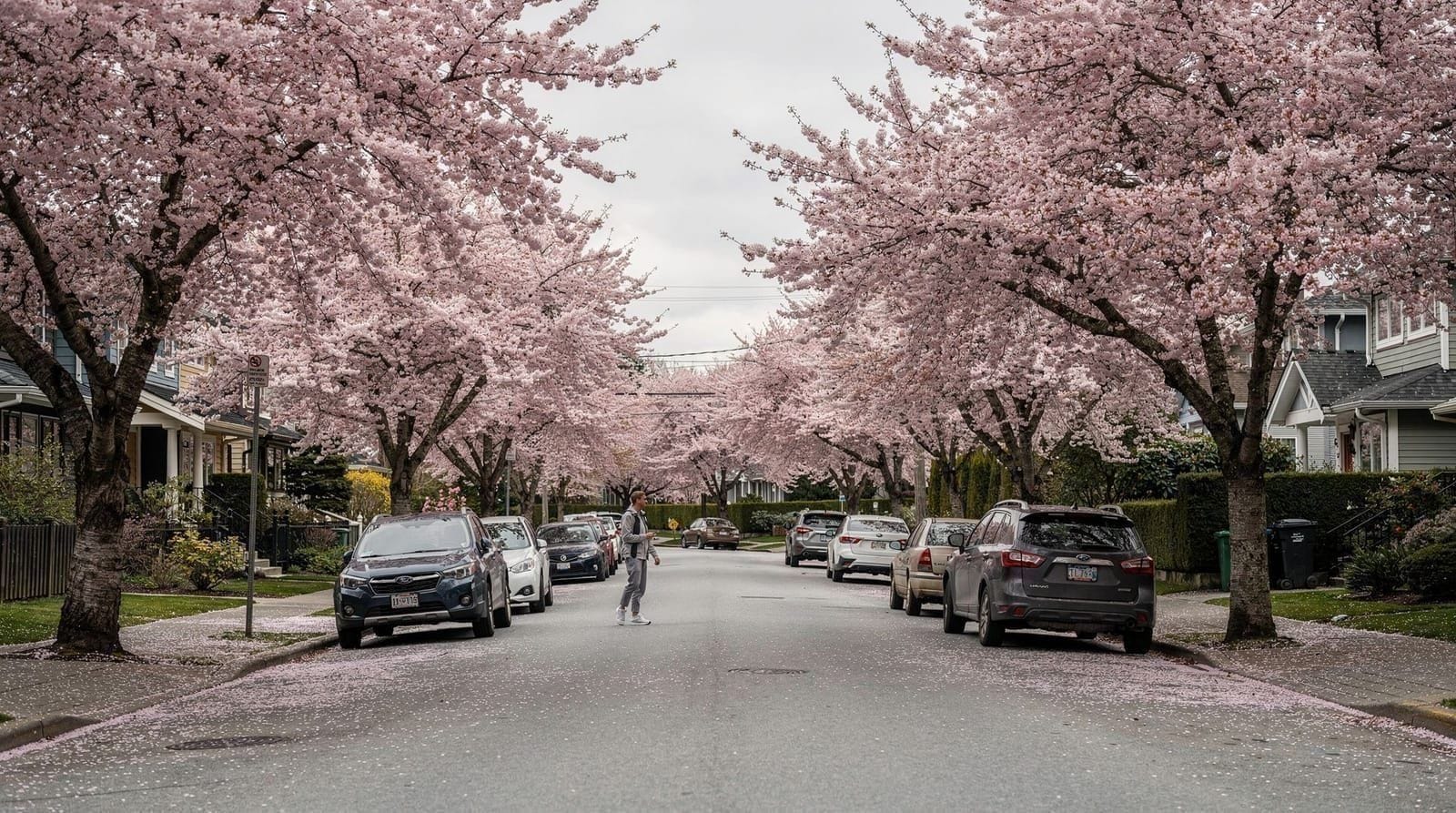
Cherry blossom season, roughly the first two weeks of April, transforms West End streets and parts of Stanley Park into some of the city’s most photogenic short-term scenes — see the cherry blossom forecast for timing detail, since the window is narrow and weather-dependent. Fall brings a different but comparable payoff at higher elevations, where deciduous trees mixed into the North Shore’s forests turn color roughly late September through October, though Vancouver’s evergreen-heavy landscape means this is a subtler effect than classic fall-foliage destinations.
Practical gear and timing notes
Vancouver’s frequent overcast conditions are, somewhat counterintuitively, a photographic asset for anyone shooting portraits or architecture — diffuse light avoids the harsh shadows of direct sun and suits Gastown’s brick facades particularly well. For anyone chasing the more dramatic golden-hour and blue-hour shots at Prospect Point, Kitsilano, or the Vancouver Lookout, checking sunset times in advance matters more here than in most cities, since Vancouver’s daylight swings dramatically by season — roughly 9:15pm sunset in July versus mid-afternoon darkness in December.
A tripod is worth carrying for anyone serious about the bridge and water shots at Prospect Point or the Vancouver Lookout’s night view, since both benefit from longer exposures that handheld shooting can’t match. For visitors without much time to scout locations independently, building photography stops into a 3-day itinerary around the golden-hour windows at Stanley Park and Kitsilano tends to produce noticeably better results than treating photo stops as an afterthought squeezed between other activities.
Underused angles beyond the obvious viewpoints
Most Vancouver photography guides repeat the same handful of postcard shots — Prospect Point, the seawall, the Gastown steam clock — without pointing toward angles that produce a more distinctive result. The SeaBus crossing between downtown and North Vancouver, a standard TransLink service rather than a tourist attraction, offers a genuinely underused waterline view of the downtown skyline that most visitors never think to shoot from, and it costs a standard transit fare rather than requiring a dedicated photography tour.
Richmond’s Steveston fishing village, with its working boats and cannery-era architecture, photographs distinctly differently from anything downtown — a rougher, more working-harbor aesthetic that stands out against the glass-tower skyline shots that dominate most Vancouver photo collections. For anyone specifically trying to build a varied portfolio rather than a single highlight reel, mixing in a stop like Steveston or the SeaBus crossing alongside the standard Stanley Park and Gastown shots produces a noticeably more complete visual story of the city.
Timing around the weather, not just the clock
Vancouver’s photography conditions change with the weather more than the clock in a way that catches visitors from more predictably sunny destinations off guard. A “golden hour” plan is only as good as the day’s actual cloud cover — persistent low cloud can erase a planned sunset shoot entirely, while a clearing sky after a rainy morning sometimes produces the most dramatic light of the whole trip, with wet streets reflecting color in a way dry pavement doesn’t. Building a day or two of flexibility into a photography-focused visit, rather than committing to a single planned shoot at a single planned time, tends to produce better results than treating the itinerary as fixed.
Pairing photography stops with the rest of a trip
Most of the locations on this list sit close enough to standard sightseeing routes that a photography focus doesn’t require a dedicated day. Stanley Park’s Prospect Point and Siwash Rock fall directly on the seawall loop most visitors already walk, and Granville Island’s water-level view works as a natural stop on the way to or from the market.
Only Grouse Mountain and a Squamish or Sea to Sky Gondola day trip genuinely require setting aside separate time, and both are worth checking against the day’s own forecast before committing, given how much clear skies matter for either location’s payoff.
Building a two-location day around the weather
For photographers with only one day and no strong preference, pairing an overcast-friendly location with a weather-dependent one hedges against a forecast that doesn’t cooperate. Gastown’s Water Street and the Vancouver Lookout’s daytime shot both hold up fine under Vancouver’s frequent cloud cover, while Prospect Point and Kitsilano need genuine clear-sky golden hour to deliver their best version. Checking the forecast the morning of and slotting the weather-dependent stop into whichever half of the day looks clearer, rather than fixing both to a rigid schedule, produces more consistent results across a full day of shooting.
Frequently asked questions about photographing Vancouver
What’s the single best sunset photo spot in Vancouver?
Kitsilano Beach, for its unobstructed west-facing view across English Bay toward the North Shore mountains. Prospect Point in Stanley Park is a close second, particularly for anyone wanting the Lions Gate Bridge in frame.
Is overcast weather bad for photography in Vancouver?
Not necessarily — diffuse cloud light softens shadows and suits architecture and portrait shots in Gastown particularly well. It’s a genuine asset for certain compositions, even if it rules out dramatic golden-hour color.
Do I need a tripod for Vancouver’s best shots?
For daytime shots, no. For long-exposure night or blue-hour shots at the Vancouver Lookout or Prospect Point, a tripod meaningfully improves results by allowing longer exposures without camera shake.
When is the best time of year for Vancouver photography?
Cherry blossom season in early-to-mid April offers the most distinctive short-term photographic opportunity, while summer’s long daylight hours (sunset around 9:15pm in July) give photographers more flexible golden-hour windows than winter’s early darkness.
Is Grouse Mountain worth the trip just for photos?
Only on a clear day — cloud cover at the summit can obscure the view entirely, so it’s worth checking the mountain’s conditions before committing a photography-focused trip up the gondola.
What time of year gives the longest golden-hour window?
Summer, since Vancouver’s daylight stretches to around 9:15pm in July, giving photographers a later, more flexible evening shooting window than winter’s much earlier sunset, which can fall in mid-afternoon around the December solstice.
Are drones allowed for photography in Vancouver’s parks?
Regulations vary by location and change over time, with restrictions common in Stanley Park and near Vancouver International Airport’s flight paths. Checking current Parks Board and Transport Canada rules before flying a drone anywhere in the city is essential rather than assuming a blanket allowance.
Is it worth hiring a local photographer instead of shooting independently?
For visitors wanting portrait-style shots of themselves or their group at key locations, yes — a local photographer knows the timing and angles that work at spots like Prospect Point or Kitsilano Beach far better than a first-time visitor working from a list alone, and can often access quieter timing windows a self-guided visitor wouldn’t think to plan around.