Richmond dumpling trail
Vancouver: Gastown Historical Walking Food Tour
Duration: 3 hours
Is there a guided dumpling tour in Richmond?
No guided dumpling tour of Richmond is currently bookable through GetYourGuide. Richmond's Chinese and Cantonese food scene, concentrated along Alexandra Road and No. 3 Road, is overwhelmingly a self-guided experience — a genuine strength for independent travelers, since dumplings here cost meaningfully less than downtown and there's no tour markup to pay.
Richmond sits about 25 minutes south of downtown Vancouver by Canada Line SkyTrain, close enough to YVR airport that many visitors pass through it without stopping, which is a genuine mistake for anyone interested in Chinese food. The city holds one of the largest concentrations of authentic Chinese, Cantonese, and Northern Chinese restaurants in North America, built up over three decades of immigration from Hong Kong, mainland China, and Taiwan, and set almost entirely in suburban strip malls rather than a walkable historic district. There is no bookable guided dumpling tour here — a fact worth stating plainly rather than glossing over, since it changes how to plan a visit, but not in a way that should discourage going.
| Where | Alexandra Road & No. 3 Road, Richmond |
| Cost | Around CAD 25-45/person for a 2-3 stop crawl |
| Getting there | Canada Line SkyTrain, ~25 min from downtown |
| Best time | Weekday lunch or early dinner |
| Booking | Self-guided; no guided tour exists here |
Why there’s no guided tour, and why that’s fine
Richmond’s food geography doesn’t lend itself to the same guided-walking-tour format that works in Gastown or on Granville Island. The city’s Chinese restaurant scene is spread across dozens of strip malls along corridors like Alexandra Road and No. 3 Road, with individual restaurants often separated by short drives rather than a five-minute walk, and a customer base that’s overwhelmingly local rather than tourist.
No guided dumpling tour currently exists in the GetYourGuide catalog for Richmond specifically, and that absence reflects the neighborhood’s DIY nature rather than a gap worth waiting to be filled. For budget-conscious or independent travelers, this is a real advantage: prices stay low precisely because restaurants aren’t paying a tour operator’s commission or adjusting menus for a steady stream of one-time visitors, and a self-guided crawl costs nothing beyond the food itself plus transit.
Alexandra Road: Richmond’s “Food Street”
Alexandra Road, a short stretch in central Richmond a few blocks from Aberdeen Station, has earned the informal nickname “Food Street” for its unusually dense concentration of Chinese restaurants packed into a handful of strip-mall plazas along both sides of the road.
Within a few blocks, the street holds dozens of restaurants specializing in distinct regional cuisines — Shanghainese soup dumpling houses, Northern Chinese hand-pulled noodle shops, Sichuan restaurants serving numbing-spice dishes, and Taiwanese beef noodle soup specialists — a level of regional specificity that’s rare even in larger Chinese food scenes elsewhere in North America. It’s compact enough to explore on foot once you’re there, though individual restaurants can have lines out the door during peak weekend meal times, particularly at the most well-reviewed soup dumpling spots.
Xiao long bao: the signature dish to seek out
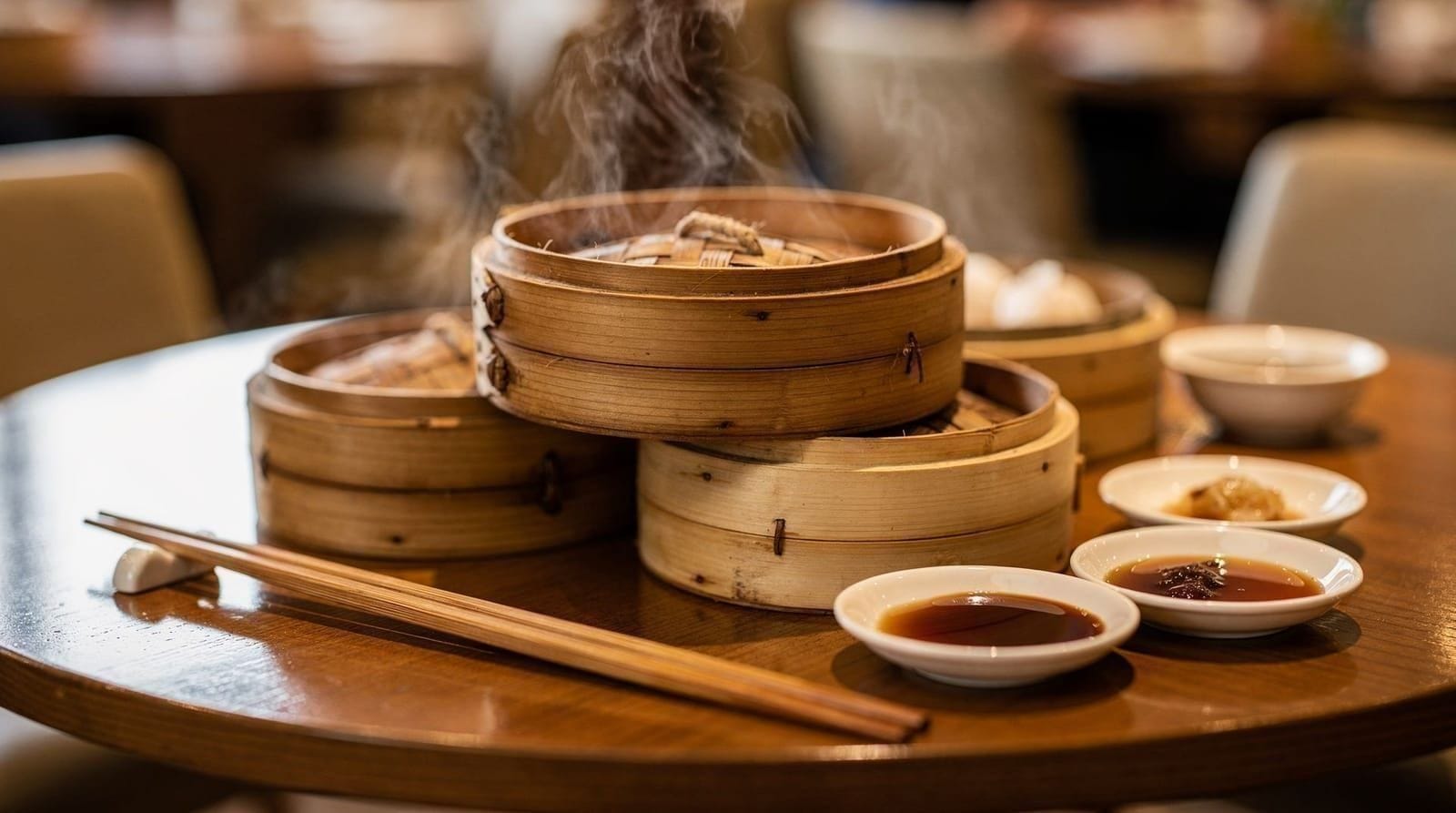
Xiao long bao, commonly translated as soup dumplings, originate from Shanghai and the surrounding Jiangnan region and represent the single dish most worth prioritizing on an Alexandra Road visit. They’re made by wrapping a small amount of gelatin-thickened pork broth alongside seasoned ground pork filling inside a thin, hand-pleated dough wrapper, which is then steamed in a bamboo basket; the gelatin melts during steaming, turning the dumpling’s interior into hot liquid soup encased in dough.
Eating them correctly matters: lift a dumpling by the pleated top with chopsticks, place it on a spoon, take a small bite to release steam, sip the broth, then eat the rest — biting into one whole without this step risks a genuine burn from the hot liquid inside.
Quality varies noticeably between restaurants; look for a thin, slightly translucent wrapper that holds together without tearing, and a broth that tastes distinctly of pork rather than mostly salt, as a rough marker of a kitchen that’s making them properly rather than from a frozen supply chain.
How to structure a self-guided crawl
The most effective approach treats Richmond like a tasting crawl rather than a single sit-down meal: pick two or three restaurants within a reasonable distance of each other, order one or two shareable dishes at each rather than a full individual meal, and pace the group so nobody fills up at the first stop.
A workable structure for a small group might start with soup dumplings and a cold appetizer at one restaurant, move to a noodle house for hand-pulled or knife-cut noodles as a second course, and finish at a bakery or dessert spot for egg tarts or shaved ice. Sharing is the norm at Chinese restaurants generally, and Richmond’s portion sizes are generous enough that even a party of two or three can reasonably sample three restaurants without excessive waste, provided orders stay modest at each stop.
Price reality: significantly cheaper than downtown
One of Richmond’s clearest advantages over a downtown food experience is price. A plate of xiao long bao (typically 6-10 pieces) runs roughly CAD 10-16 at most Alexandra Road restaurants, a bowl of hand-pulled noodles CAD 10-14, and most individual dishes fall in the CAD 8-15 range — noticeably below the CAD 15-25-plus common for a comparable dish at a downtown Vancouver restaurant.
This price gap reflects Richmond’s suburban commercial rents and a customer base of local Chinese-Canadian families and workers rather than visitors, which keeps menus honestly priced rather than adjusted upward for tourist traffic. A full crawl across two or three restaurants, shared among two to four people, typically lands in the CAD 25-45 per-person range including tax and a reasonable tip — a fraction of what a downtown guided food tour costs, and without any tour-operator markup built into the experience.
Combining Richmond with the Night Market
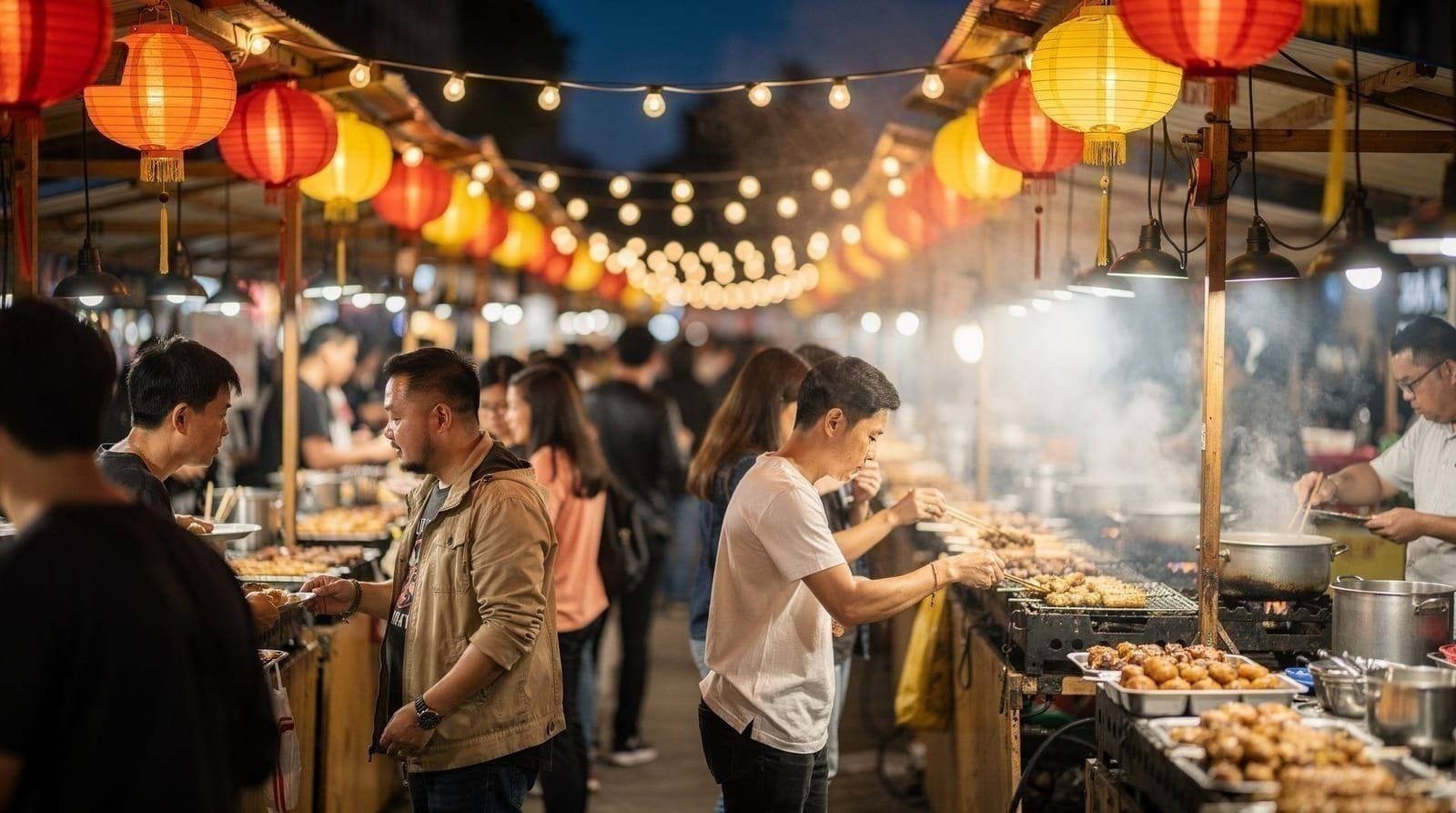
Richmond hosts a seasonal night market, running roughly May through October, that adds a completely different food experience to a Richmond visit — closer to a street-food festival than a sit-down restaurant crawl, with dozens of vendor stalls selling snack-sized portions of everything from Hong Kong-style egg waffles to grilled skewers and bubble tea.
It’s worth combining with an Alexandra Road visit if your trip dates overlap with the market’s season, since the two experiences complement each other well: Alexandra Road for a proper sit-down meal earlier in the day, the night market for grazing and snacking in the evening. Full details, including hours and how to get there, are in the Richmond Night Market guide.
Getting around Richmond: walkable pockets, not a walkable city
Richmond overall is not a walkable city in the way downtown Vancouver or Gastown are — it’s built around wide arterial roads and car-oriented strip-mall development, and most of the city requires a vehicle or transit to navigate. The good news for a food crawl specifically is that the densest restaurant clusters, particularly the core of Alexandra Road, are walkable within themselves once you’ve arrived.
Moving between two separate clusters — say, from Alexandra Road to a second concentration of restaurants along No. 3 Road — typically requires a short drive or a five-to-ten-minute rideshare rather than a walk, since these corridors sit a couple of kilometers apart with unwalkable stretches of parking lots and wide roads in between. Budgeting for one or two short rideshare hops (typically CAD 8-12 each within Richmond) keeps a multi-cluster crawl realistic without a rental car.
Getting to Richmond from downtown Vancouver
The Canada Line SkyTrain is the simplest way to reach Richmond from downtown, running directly from Waterfront, Vancouver City Centre, and other downtown stations to Aberdeen Station (closest to the core of Alexandra Road) or Lansdowne Station, in roughly 25 minutes with no transfers. A single SkyTrain fare runs about CAD 3-4 depending on the time of day and fare zone.
From Aberdeen Station, Alexandra Road’s restaurant cluster is a short walk of five to ten minutes; from Lansdowne, it’s slightly farther but still walkable, or a very short rideshare. Because Richmond sits directly between downtown Vancouver and YVR airport on the Canada Line, it’s also a genuinely practical stop on a departure day — a dumpling lunch on the way to catch a flight, with luggage in tow, is a realistic plan given the short SkyTrain hop from Richmond to the airport terminal.
Dietary notes
Vegetarian options exist at most Richmond restaurants but require some navigation, since many dishes use pork or chicken broth as a base even when the visible ingredients look vegetable-forward — asking directly about broth and sauce ingredients is worth doing rather than assuming a dish is vegetarian from its description alone.
Vegan requests are more limited still, though dedicated vegetarian Chinese restaurants do exist in the broader Richmond area and are worth seeking out specifically if needed. Gluten-free dining is genuinely difficult here: most dumpling wrappers and noodles are wheat-based by definition, and rice-based alternatives (rice noodles, certain rice-flour dumplings) are the more realistic option to look for rather than expecting substitutions at a dumpling-focused restaurant.
Peanut and other nut allergies warrant real caution given how commonly nuts and nut oils appear across Northern Chinese and Sichuan dishes specifically — flagging allergies clearly when ordering, ideally with the dish name written down or shown on a phone, reduces miscommunication risk.
Best time of day and week to go
Weekday lunch, roughly 11:30am to 1:30pm, and early weekday dinner, before 6pm, are the quietest windows at Alexandra Road’s most popular restaurants, avoiding both the local lunch rush from nearby offices and the heavier weekend crowds.
Weekend evenings, particularly Friday and Saturday from 6pm to 8pm, see the longest waits at well-known soup dumpling and noodle spots, sometimes 30-45 minutes for a table without a reservation — a real consideration if a crawl is meant to hit three restaurants in an afternoon rather than spending most of the visit standing in line at the first one. Some of Richmond’s most popular restaurants take reservations through phone or third-party apps, worth checking ahead if a specific place is a priority rather than a flexible stop on a broader crawl.
Comparing to Chinatown’s dim sum scene
Chinatown, closer to downtown Vancouver, offers a different and equally worthwhile Chinese food experience, centered more on Cantonese dim sum served in an older, historically significant urban setting rather than Richmond’s suburban strip-mall sprawl. Chinatown’s dim sum restaurants tend to be larger, more traditional banquet-style spaces with rolling carts or order-sheet service, while Richmond’s Alexandra Road leans toward smaller, specialty restaurants each focused tightly on one regional style or dish. Pricing in Chinatown runs somewhat higher than Richmond, reflecting downtown rents and a mixed local-and-tourist customer base, though still generally reasonable compared to a typical downtown restaurant meal.
Travelers with time for only one of the two should consider format preference: Chinatown for dim sum specifically, in a walkable, historically rich neighborhood; Richmond for the widest regional variety of Chinese cuisine and the lowest prices, at the cost of needing transit or a car to move between clusters.
If you’d rather have a guided tasting-tour experience
For travelers who prefer the convenience of a guided format — fixed pricing, curated stops, no need to research restaurants or navigate strip malls independently — the closest equivalent bookable experiences sit within Vancouver proper rather than in Richmond itself. A Gastown walking food tour covers a comparable multi-stop tasting format, including dumpling and dim sum-style counters, within an easily walkable downtown-adjacent neighborhood, and a Granville Island food walking tour offers a market-based alternative with a broader mix of cuisines beyond Chinese food specifically.
Neither substitutes for an actual Richmond visit if regional Chinese cuisine specifically is the goal, but both are reasonable options for travelers who want a guided tasting experience somewhere in the city and don’t want to build their own Richmond itinerary from scratch.
Combining Richmond with the rest of a Vancouver trip
Because Richmond sits on the Canada Line directly between downtown and the airport, it fits naturally into either an arrival or departure day rather than requiring a dedicated day trip pulled from elsewhere in a Vancouver itinerary. Visitors flying into YVR can stop at Alexandra Road for a first meal in the city before continuing to a downtown hotel, and those flying out can do the reverse on a departure day, provided there’s enough buffer before a flight.
For a broader look at how Richmond’s food scene compares to Vancouver’s other guided and self-guided tasting experiences, see the best food tours in Vancouver roundup, which covers Richmond alongside Gastown, Granville Island, and the craft beer scene in Mount Pleasant.
Common mistakes to avoid
The most common mistake is treating the first restaurant as the only stop and over-ordering there, leaving no appetite for the second or third planned stop — pacing matters more in Richmond than almost anywhere else in the city, given how many worthwhile restaurants sit within a short distance of each other. A second common mistake is showing up on a Saturday evening without a reservation or backup plan and losing 30-45 minutes to a line at the single most-reviewed restaurant, when a five-minute walk in either direction usually turns up an equally good, less crowded alternative.
Finally, some visitors underestimate the distance between Alexandra Road and other Richmond food clusters, assuming the whole city is as walkable as the Food Street core — checking a map and budgeting for a short rideshare between clusters avoids an unplanned long walk along a car-oriented arterial road with no real sidewalk life.
Beyond dumplings: what else Richmond’s food scene offers
While dumplings and noodles are the headline draw, Richmond’s Chinese food scene extends well beyond those two categories, and a longer visit benefits from knowing what else is on offer. Hong Kong-style bakeries selling egg tarts, pineapple buns, and barbecue pork buns are common along both Alexandra Road and No. 3 Road, useful as a mid-crawl snack that doesn’t compete with a full noodle or dumpling course.
Hot pot restaurants, where diners cook thinly sliced meats and vegetables at the table in a simmering broth, are a popular dinner option better suited to a dedicated evening than a quick crawl stop, given the format’s slower pace. Seafood restaurants specializing in Cantonese-style whole fish and shellfish dishes also cluster in Richmond, generally priced by weight and better suited to a group of four or more sharing a full meal than a two-person tasting crawl. Bubble tea shops are everywhere, useful as a low-commitment stop to break up a food-heavy day.
Regional cuisines represented along the corridor
Part of what makes Richmond distinctive within the broader Vancouver food scene is the sheer regional range packed into a few strip-mall corridors. Beyond Shanghainese soup dumplings, the area holds a genuine concentration of Northern Chinese restaurants serving hand-pulled or knife-cut wheat noodles in savory broths, Sichuan restaurants known for the numbing heat of Sichuan peppercorn dishes like mapo tofu and dan dan noodles, Taiwanese restaurants serving beef noodle soup and popcorn chicken, and Cantonese restaurants covering both dim sum and full banquet-style dinners.
This regional breadth is unusual even for major North American Chinatowns, most of which lean heavily Cantonese; Richmond’s more recent immigration waves from mainland China and Taiwan since the 1990s and 2000s brought a wider spread of regional cooking styles that settled specifically into this suburban corridor rather than an older, single-heritage urban Chinatown.
Parking and driving to Richmond
Travelers with a rental car have an easier time reaching Richmond than transit-only visitors, since it’s roughly a 20-25 minute drive from downtown Vancouver via Oak Street or the Knight Street Bridge, depending on traffic and starting point. Most Alexandra Road and No. 3 Road strip-mall plazas offer free surface parking directly in front of restaurants, a genuine contrast to downtown Vancouver’s metered and often expensive parking.
The tradeoff is that driving reintroduces the logistics of finding parking at each stop on a multi-restaurant crawl and navigating Richmond’s wide, car-oriented arterial roads between clusters — for a single cluster visit focused entirely on Alexandra Road, transit is often just as convenient and removes the parking question entirely.
Language and ordering tips
Menus at most Alexandra Road restaurants include English translations alongside Chinese characters, though translation quality varies and dish descriptions can be terse. Staff at busier, more established restaurants are generally used to a mixed local and occasional visitor clientele and can usually help in English if asked, though English fluency varies restaurant to restaurant, particularly at smaller, family-run spots.
Pointing at a photo on the menu or at another table’s dish is a normal and accepted way to order if a description is unclear — nobody will find this unusual in a neighborhood this food-focused. Cash is still accepted everywhere, but most restaurants along the corridor now take major credit and debit cards as well, a shift from a decade ago when cash-only was more common.
Bottom line
Richmond’s dumpling scene rewards travelers willing to do a small amount of their own planning in exchange for meaningfully lower prices, a wider regional range of Chinese cuisine than anywhere else in the city, and food built for a local customer base rather than adjusted for tourists. The absence of a guided tour here isn’t a gap so much as a reflection of the neighborhood’s nature — spread across strip malls, priced for locals, and best explored at your own pace with a short SkyTrain ride and a bit of restaurant research rather than a fixed itinerary.
For travelers who’d still rather have a curated, guided tasting format, Gastown and Granville Island cover that need within Vancouver proper; for anyone comfortable navigating a menu and ordering a few shared dishes, Richmond delivers some of the best value and most authentic regional Chinese food in the entire metro area.
Planning a Richmond food crawl around flight times
Because Richmond sits directly between downtown Vancouver and YVR on the Canada Line, it’s a genuinely practical stop for either an arrival or departure day rather than requiring a dedicated day trip pulled from elsewhere in an itinerary. Travelers arriving with a few hours before hotel check-in can drop luggage at a Richmond restaurant’s coat check or simply keep bags with them for a quick meal before continuing downtown. Travelers departing later in the day can plan a final Richmond meal with enough buffer before their flight — typically an hour or more before needing to be back on the SkyTrain toward the airport, factoring in the short ride and standard security time.
Building a two-restaurant versus three-restaurant crawl
A two-restaurant crawl suits travelers with limited time or appetite, typically pairing a soup dumpling stop with one other course — a noodle house or a bakery for dessert — and keeps the whole outing to roughly ninety minutes to two hours including transit within Richmond.
A three-restaurant crawl stretches the outing closer to three hours and works better for a group willing to pace themselves across a full afternoon or evening, sampling a wider regional range rather than concentrating on one or two dishes. Neither approach is wrong; matching the crawl’s length to the group’s appetite and patience for moving between strip-mall plazas tends to produce a better outcome than defaulting to the longest possible version out of a sense that more stops means more value.
What repeat visitors do differently
Travelers who’ve done a Richmond food crawl once tend to approach a second visit differently than a first-timer would — rather than trying to hit the most-reviewed restaurants again, many deliberately seek out a specific regional cuisine they missed the first time, whether that’s Sichuan numbing-spice dishes, Taiwanese beef noodle soup, or a specific bakery’s pastries. Repeat visitors also tend to know which restaurants handle weekend crowds better and plan around that, either avoiding peak times entirely or accepting a short wait at a specific favorite rather than defaulting to whichever spot has the shortest line that day.
A note on portion sizes and pacing for larger groups
Groups of four or more get meaningfully more value out of a Richmond crawl than a pair or solo traveler, since larger groups can order a wider spread of dishes at each stop and share everything, sampling more of a restaurant’s menu without excessive waste. Smaller groups or solo travelers should scale expectations accordingly — ordering one or two dishes per stop rather than the fuller spread a group of four might order, and accepting that a solo crawl covers less breadth per restaurant even while still delivering good value compared to a single downtown meal.
Frequently asked questions — Richmond dumpling trail
How do I get to Richmond's Alexandra Road from downtown Vancouver?
Take the Canada Line SkyTrain to Aberdeen or Lansdowne Station, roughly 25 minutes from downtown Vancouver stations. Alexandra Road is a short walk or a quick rideshare from either stop.What are xiao long bao?
Soup dumplings originally from Shanghai and the Jiangnan region, made by wrapping a gelatin-thickened broth alongside seasoned pork filling inside a thin dough wrapper, which steams into liquid soup. They're eaten with a spoon to catch the broth, not popped whole into your mouth, to avoid a burn.Is Richmond food cheaper than downtown Vancouver?
Yes, generally. A dumpling or noodle dish in Richmond typically runs CAD 8-15, compared to CAD 15-25 or more for a comparable dish at a downtown restaurant, reflecting Richmond's strip-mall rents and largely local, non-tourist customer base.Do I need a car to do the Richmond dumpling trail?
No, but some walking or short rideshare hops between strip malls are usually needed. Alexandra Road's core stretch is walkable on its own, but reaching a second cluster on No. 3 Road typically means a short drive or rideshare rather than a walk.When is the best time to visit Richmond for dumplings?
Weekday lunch or early dinner avoids the heaviest weekend crowds at the most popular spots, some of which post 30-45 minute waits on Saturday and Sunday evenings. Summer visits can be combined with the Richmond Night Market, which runs seasonally.How is Richmond's food scene different from Chinatown's?
Chinatown's food centers on Cantonese dim sum in an older, more historic urban setting with some tourist-oriented pricing. Richmond's scene is broader regionally (Cantonese, Northern Chinese, Shanghainese, Taiwanese and more), set in strip malls, and priced for a largely local Chinese-Canadian customer base rather than visitors.Should I order a lot of dishes or stick to one restaurant?
Order a lot, shared across a small group, and spread it across two or three restaurants rather than filling up at the first stop. Portions at most Richmond dumpling and noodle spots are generous and inexpensive enough that a proper crawl beats a single big meal.
Top experiences
Bookable activities with verified prices and instant confirmation on GetYourGuide.