Best time for whale watching in British Columbia
Vancouver: Whale & Wildlife Watching Tour with Free Photos
When is the best time for whale watching in BC?
BC's whale watching season runs April through October. Resident and transient orcas peak from late June to early September, while humpback whales are most reliable from July through October, peaking in August and September. September is the single best month to try for both species on the same trip.
Ask ten operators in BC when the “best” whale watching month is and you’ll get ten slightly different answers, mostly because they’re each answering for their own dock. The honest version is that it depends on which species you want, how much crowding and price you’ll tolerate, and which region you’re departing from — orcas and humpbacks don’t move on the same calendar, and neither Vancouver nor Victoria nor northern Vancouver Island peaks at exactly the same time.
| Season | April-October |
| Orca peak | Late June-early September |
| Humpback peak | August-September |
| Best combined month | September |
| Cost | Around CAD 130-180 (Vancouver), 120-160 (Victoria) |
The season in one paragraph
BC’s whale watching season runs April through October, with a few operators pushing trips slightly earlier or later depending on conditions. Within that window, resident and transient (Bigg’s) orcas are most reliably sighted from late June through early September, while humpback whales build through July and peak in August and September before tapering into October. There’s real overlap in the middle of the season, and September in particular is worth treating as its own category — more on that below. Outside April-October, sightings are inconsistent enough that most operators scale back or pause trips, so it’s not a realistic window to plan around.
Month-by-month calendar
April. The opening edge of the season. Orcas are starting to move back into the Salish Sea and Georgia Strait after winter, and a handful of operators run early trips, but sighting odds are noticeably lower than peak summer and some tours don’t launch until later in the month. What April does offer is near-empty boats and the lowest prices of the season — a reasonable trade if you’re flexible and more interested in a quiet trip than a guaranteed sighting.
May. Similar story to April but improving. Resident orca pods become more consistent visitors to their usual Salish Sea routes, and a few early humpbacks start showing up, though not in numbers worth planning a trip around yet. Crowds are still light and this is a good shoulder-season pick if your travel dates are fixed and happen to fall here.
June. The real ramp-up. By late June, orca sightings move into what most operators would call peak territory, and this is genuinely the start of the best stretch for orca-focused trips. Humpback numbers are still building. Weather is also typically more settled than earlier spring months, which matters more than people expect — a calm strait makes for a far more comfortable open-boat trip.
July. Orca season is in full swing and this is also when humpback sightings start climbing meaningfully. It’s also peak tourist season generally, so boats fill up, prices sit at the higher end of the CAD 130-180 range for Vancouver departures, and advance booking matters more than at any other point outside August.
August. The single busiest month for whale watching bookings in BC, and for good reason — orca sightings are still strong through most of the month, and humpback numbers are approaching their own peak. This is the month to book earliest if your travel dates are fixed, particularly for Victoria departures, which see the heaviest demand of any BC whale watching hub.
September. The overlap sweet spot. Orca sightings remain solid through the first half of the month even as the true peak fades, and humpback sightings are typically at or near their annual high. Crowds ease slightly compared to July-August, and some operators quietly reduce prices as the shoulder season begins. If you can only pick one month and want the best chance at seeing both species without July-August crowd levels, this is it — a theme covered in more depth in the orca vs. humpback season comparison.
October. The tail end. Orca sightings drop off notably, but humpbacks are often still present in good numbers as they linger before their migration south, so this remains a genuinely decent humpback-focused month. The trade-off is weather — Pacific storm systems start arriving more frequently, and open Zodiac tours in particular can get choppy or get cancelled outright. Covered boats hold up better in marginal conditions.
What “success rate” actually measures
Numbers like “85-90%+” get thrown around a lot in whale watching marketing, and it’s worth understanding what they actually represent before treating them as a guarantee. Success rates are typically self-reported by operators based on whether a whale — any whale, of any species — was sighted during a trip, aggregated over a season or a multi-year average.
They’re not a promise for any specific departure, and they’re heavily weighted by season: an operator’s year-round average blends peak-summer trips running close to 100% with shoulder-season trips running considerably lower, so the headline number can overstate what a random April Tuesday actually looks like. Treat published success rates as a reasonable guide to which region and season to prioritize, not as a per-trip guarantee — weather, recent prey movements and pure chance all still matter on any individual day.
Crowd and price patterns across the season
Demand for BC whale watching follows a fairly predictable curve that’s worth planning around independently of sighting odds. April and May are the quietest months of the season — boats often go out with plenty of open seats, and prices sit at or near their annual low. June sees demand pick up steadily as schools finish and family travel begins in earnest.
July and August are the peak of both sightings and demand simultaneously, which means the best odds of the year coincide with the fullest boats, the highest prices, and the tightest booking windows — Victoria departures in particular are frequently sold out days or weeks ahead during this stretch. September brings genuine relief on the crowd front: sightings are still strong, but family travel drops off after Labour Day, and several operators quietly ease pricing as part of a broader shoulder-season pattern. October sees a further, more pronounced drop in both demand and price, offset by the weather risk described below.
The practical takeaway is that July and August reward advance planning specifically because supply is genuinely constrained, not because odds are meaningfully better than September’s — for travelers with flexible dates, shifting a trip from August into September often means comparable sightings, smaller crowds and a somewhat easier and sometimes cheaper booking process.
Weather and sea conditions by season
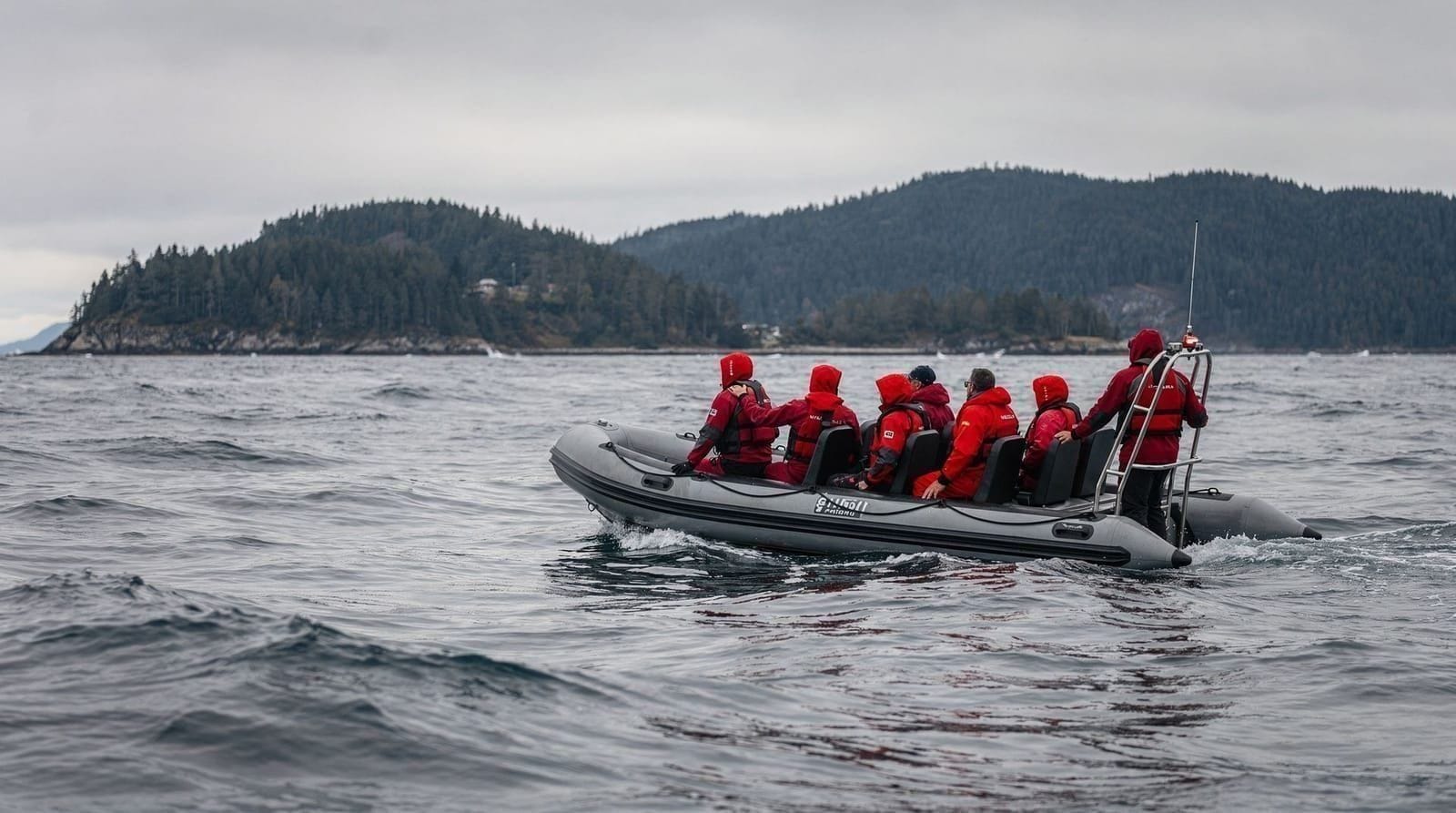
Sea conditions shift as much as sightings across the season, and they matter more for comfort — and for which boat type makes sense — than most first-time bookers expect. Late spring through summer, roughly June through early September, is BC’s most settled weather window, with the Strait of Georgia and Juan de Fuca Strait typically calmer and more forecast-consistent than at any other point in the year. This is also when open Zodiac tours make the most sense, since rough water is the main thing that makes an open boat genuinely uncomfortable rather than just bracing.
Spring (April-May) and especially fall (October) bring more variable Pacific weather systems, with a real chance of wind and swell picking up enough to affect the ride, and occasionally enough to trigger a cancellation. Covered and catamaran-style boats handle this variability considerably better than open Zodiacs, which is part of why it’s worth matching boat type to season rather than picking purely on preference — an open Zodiac booked for a late-October trip is a meaningfully rougher gamble than the same boat type in July.
Comparing the regions, not just the months
Timing only answers half the question — where you depart from changes the odds as much as when you go.
Vancouver is the most convenient base if you’re not planning to leave the city, with tours departing from Coal Harbour and Granville Island in the CAD 130-180 range for 3-5 hours. It’s a genuinely fine option, but it’s honest to say Vancouver isn’t the top-odds region in the province — the boats travel further to reach the most productive waters, and success rates run somewhat below Victoria’s, especially outside July-September.
Victoria, on Vancouver Island, is widely regarded as one of the best whale watching bases anywhere, largely because of its direct proximity to Salish Sea and Juan de Fuca Strait routes that resident and transient orca pods travel consistently. Market data puts success rates there in the 85-90%+ range during peak months. The catch is logistics — reaching Victoria from Vancouver means a ferry or seaplane trip, so it works best as an overnight stay rather than a rushed day trip.
Telegraph Cove, on northern Vancouver Island, has some of the strongest sighting odds in the province for both orcas and humpbacks, partly thanks to nearby rubbing beaches that resident pods use regularly. A Telegraph Cove whale watching tour isn’t realistic as a Vancouver day trip, though — it’s a 4-5 hour drive from the city, and it only makes sense as part of a multi-day Vancouver Island itinerary rather than a quick add-on.
Campbell River, roughly midway up Vancouver Island, offers a different kind of trip: a combined whale and wildlife boat tour that broadens the target beyond whales to include seals, sea lions and eagles along the way. It suits travelers who want a wildlife-focused outing rather than a whale-only trip, and it’s a reasonable stop on a longer northern Vancouver Island route.
Choosing a tour once you’ve picked a month
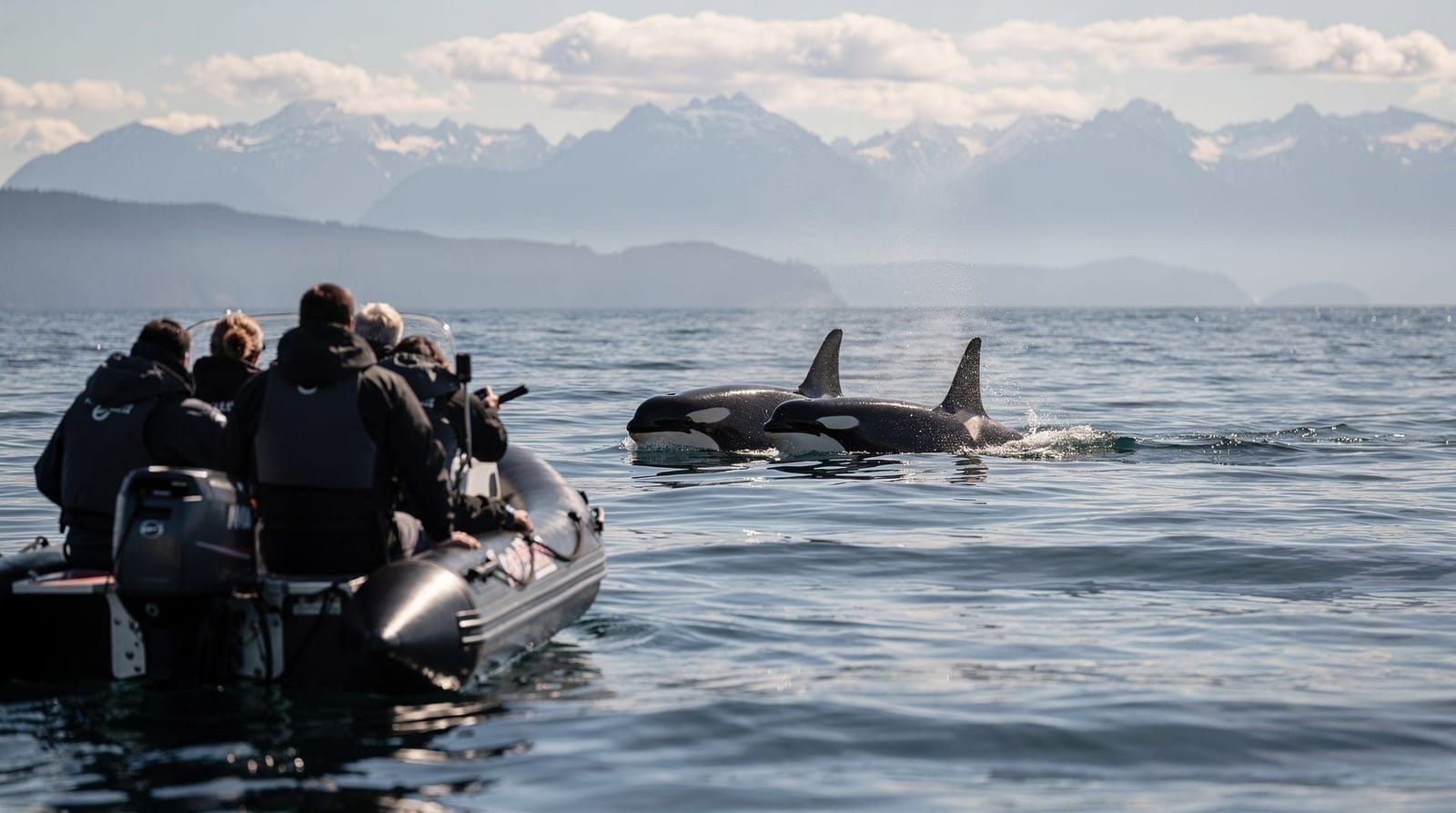
Once you know roughly when you’re going, the boat type matters more than most people expect. Covered or catamaran-style boats — like the Vancouver whale and wildlife watching tour — trade some of the up-close, engine-in-your-ears immediacy of an open Zodiac for warmth, seating and washroom access, which matters a lot on a cool April morning or a blustery October afternoon.
Zodiacs sit lower and closer to the water, which some travelers genuinely prefer for photography and the sense of scale, but they’re a rougher, colder ride and less forgiving in marginal weather — worth weighing against the season you’re booking into, not just personal preference in the abstract.
Whichever month and region you land on, pack for conditions colder than the air temperature suggests. Open water off BC runs cool even in August, and boats build their own wind chill at speed — a windbreaker and a warm layer underneath serve better than a light jacket, regardless of which tour type you book.
Building the rest of the trip around it
Whale watching pairs naturally with other water-based activities if you’re spending more than a day or two in the region. Travelers based in Vancouver often combine a whale watching morning with an afternoon of kayaking or a paddle out from Deep Cove, since both run on similar seasonal logic — calmer water and better weather from June through September. A day trip to Bowen Island or a sailing tour works as a lower-key alternative on a day when whale watching isn’t in the budget or the schedule.
If wildlife is the running theme of the trip rather than whales specifically, it’s worth reading across to grizzly bear viewing near Campbell River, eagle watching in Squamish and the broader wildlife tours from Vancouver roundup, since several of these run on the same April-October seasonal window and can be stacked into a single multi-day itinerary without much conflict.
Base camp also matters for logistics. Tours departing from Granville Island are an easy walk or short drive from most downtown Vancouver hotels, while North Vancouver stays add a short bridge crossing to reach the same docks — a minor factor, but worth building into an early-morning departure time.
Booking lead times across the season
How far ahead to book depends heavily on which month and region are in play. For July and August departures from Victoria — the single tightest combination of high demand and constrained supply anywhere in BC whale watching — booking two to four weeks ahead is a reasonable target for weekend dates, and even weekday slots can sell out during the busiest stretches of August. Vancouver departures in the same months are somewhat more forgiving, generally bookable within a week or two out, though weekend mornings still fill first.
September and June both loosen considerably, often bookable within a few days, and April, May and October rarely require more than a couple of days’ notice except around long weekends or school holidays. Telegraph Cove and Campbell River, given their smaller operator base and more specialized traveler pool, are worth booking slightly further ahead than the raw demand might suggest, simply because there are fewer boats and less flexibility if one trip sells out.
A first-time visitor’s decision guide
For travelers who haven’t been through this decision before, it helps to work through it as a short series of questions rather than trying to absorb every regional and seasonal detail at once.
If the travel dates are already fixed and fall between June and September, the main decision is region, not timing — pick Victoria if maximizing raw odds matters most and an overnight stay or long day trip is workable, or Vancouver if convenience and staying based in one city matters more than squeezing out the last few percentage points of sighting probability. If the dates are fixed outside June-September, treat the trip as a bonus rather than the centerpiece of the itinerary, since odds outside the core window are real but noticeably lower, and build in a backup activity in case the tour comes up empty.
If the dates are flexible, September is the strongest all-around answer for most travelers, balancing sightings, crowds and price better than any other single month. Travelers whose main goal is specifically an orca sighting should lean toward late June through August and prioritize Victoria; travelers most interested in humpback behavior — breaching, tail-slapping — should lean toward August through October and note that both Vancouver and Victoria have decent odds by that point in the season.
Finally, if the trip includes several days on Vancouver Island rather than just a Victoria day trip, it’s worth seriously considering Telegraph Cove over a second Victoria-based tour — the odds there are genuinely excellent for both species, and it offers a meaningfully different kind of encounter than a second trip repeating the same Salish Sea route.
Off-season and near-winter sightings
It’s worth addressing directly what happens outside the April-October window, since a handful of travelers end up in BC during winter and wonder if a tour is still worth pursuing. A small number of operators run limited winter trips, mostly targeting transient orcas — which, unlike resident pods, don’t disappear from the region as reliably in the colder months — but sightings are inconsistent enough, and sea conditions rough enough, that this isn’t a realistic option to plan a trip around.
Most operators simply pause entirely between November and March. If a trip happens to fall in this window, it’s worth treating whale watching as off the table for that visit rather than trying to force it, and instead leaning on land-based wildlife options or planning a return trip for the proper season.
Choosing between the four bookable tour options
Once the season and region are decided, the choice narrows to which specific tour to book. The Vancouver whale and wildlife watching tour suits travelers staying based in the city who don’t want to add a ferry crossing or overnight stay. The Victoria catamaran whale watching tour is the pick for anyone prioritizing raw orca odds and already planning a Victoria overnight or a long day trip.
The Telegraph Cove tour only makes sense within a multi-day Vancouver Island loop given the drive involved, but rewards that commitment with some of the province’s strongest sighting odds. And the Campbell River wildlife boat tour suits travelers who want a broader wildlife outing — seals, sea lions, eagles alongside whales — rather than a whale-focused trip specifically.
Weather versus sea-state cancellations
It’s worth separating two things that get conflated when travelers ask whether rain affects whale watching: rain itself and sea state. Light rain rarely cancels a tour — whales don’t care about drizzle, and covered boats in particular handle it without issue. Wind and swell are the actual triggers for cancellation, since a genuinely rough Strait of Georgia or Juan de Fuca crossing is both uncomfortable and, past a certain point, unsafe for an open Zodiac specifically.
A rainy but calm day is a perfectly fine day to go whale watching; a dry but windy day is more likely to see a tour cancelled or rescheduled. Checking the marine forecast for wind speed, rather than the general weather forecast for rain, is the more useful habit for anyone deciding whether to book same-day.
Packing for the boat regardless of season
Because open water off BC runs cooler than the air temperature on land suggests, and boats build additional wind chill at speed, dressing in layers matters on every whale watching tour regardless of month. A warm base layer, a windproof and waterproof outer shell, and closed-toe shoes are the baseline; gloves are worth adding for April, May and October departures specifically, when air temperatures alone are already cooler before the boat’s own wind chill is factored in. Covered and catamaran-style boats are more forgiving of underdressing than open Zodiacs, but treating every departure as if it will be genuinely cold on the water — even in the middle of August — avoids the most common first-timer mistake on this kind of tour.
The bottom line
If a specific week is already fixed, don’t over-optimize the month — any trip from June through September will give reasonable odds at one species or the other, and a good operator with a strong local sighting record matters more than the calendar date within that window. If the dates are still flexible, September is the strongest single choice for balancing species variety, crowd levels and price, with late June through August as the safer bet if orcas specifically are the priority. Whatever the timing, matching the region to the goal — Victoria for the best raw orca odds, Vancouver for convenience, Telegraph Cove for a dedicated Vancouver Island wildlife trip — matters as much as picking the right month.
Frequently asked questions — Best time for whale watching in British Columbia
What is the best month to see both orcas and humpbacks in BC?
September. Orca sightings are still strong through the first half of the month, and humpback numbers are climbing toward their August-September peak, so operators in both Victoria and around Vancouver report solid combined odds. It's also past the July-August crowd peak, so boats are less full and prices often ease slightly.Does whale watching season ever start before April or run past October?
Some operators run limited trips outside the April-October window, but sightings drop off sharply and a few companies pause entirely in the depths of winter. Treat April and October as the realistic edges of the season rather than firm cutoffs — early and late trips exist but come with lower odds and rougher water.Is Victoria really better than Vancouver for whale watching?
For orcas specifically, yes — Victoria sits closer to the Salish Sea and Juan de Fuca Strait routes that resident and transient pods travel most consistently, and operators there report success rates in the 85-90%+ range through peak season. Vancouver-based tours cover some of the same waters but with a longer transit, so odds run somewhat lower, particularly outside peak months.Are humpback whales a new thing in BC waters?
Relatively, yes. Humpback populations were hunted to near-local extinction in BC through the mid-20th century and have only rebounded meaningfully over roughly the past 15-20 years, to the point where sightings in the Salish Sea and Georgia Strait are now a normal part of a summer tour rather than a rare bonus.How much does a whale watching tour cost in BC?
Most half-day to full-day tours from Vancouver or Victoria run roughly CAD 130-180, with Victoria trips sometimes priced a little lower, around CAD 120-160. Open Zodiac tours and covered/catamaran boats fall in similar ranges; the price difference tends to come from trip length and operator rather than boat type alone.Should I book a whale watching tour in advance?
Yes, especially for July and August departures from Victoria, which are the most heavily booked window of the year. April, May, June and October have more flexibility, but a specific departure time on a specific boat is still worth locking in a few days ahead rather than same-day.What happens if no whales are sighted on a tour?
Most reputable operators in BC offer a free rebooking or a partial-credit policy if no whales are seen, though exact terms vary by company and season, so it's worth checking before booking. This is more of a formality than a real risk during peak months, when sighting rates are highest.Is Telegraph Cove or Tofino a better whale watching base than Vancouver or Victoria?
Telegraph Cove, on northern Vancouver Island, has some of the most consistent sighting odds in the province because it sits near resident orca rubbing beaches and dense humpback feeding grounds, but it's a 4-5 hour drive from Vancouver and only realistic as part of a multi-day Vancouver Island trip, not a day trip. Tofino leans more toward grey whales and coastal wildlife than orca-focused trips.Do whale watching tours run in the rain?
Generally yes, within the April-October season — light rain doesn't typically cancel a tour, since whales don't care about drizzle any more than the boats do. Operators cancel or reschedule mainly for wind and sea-state safety reasons rather than rain alone, so a grey-sky forecast shouldn't be a reason to skip booking during the working season.What should I wear on a whale watching tour?
Layers, regardless of season — a warm base layer, a windproof and waterproof outer shell, and closed-toe shoes, since open water off BC runs cool even in August and boats build their own wind chill at speed. Covered boats are somewhat more forgiving than open Zodiacs, but dressing warm is worth it either way.
Top experiences
Bookable activities with verified prices and instant confirmation on GetYourGuide.